


Basically
NFT stands for Non-Fungible Token.
It’s a unique digital certificate recorded on a blockchain that proves ownership, authenticity, and origin of something — physical or digital.
Where Bitcoin represents money, NFTs represent things.
Each NFT is one-of-a-kind, traceable, and programmable.
You can think of it as a digital deed — a tamper-proof title that says “this specific item belongs to this specific wallet.”
Fungible vs non-fungible
Fungible = interchangeable.
One dollar is the same as any other dollar.
One Bitcoin equals any other Bitcoin.Non-fungible = unique.
A house deed, a medical license, or a one-of-a-kind ticket isn’t interchangeable.
NFTs make non-fungible things manageable in the digital world. They bring uniqueness to a space that used to only do copies.
What an NFT actually is (the technical truth)
An NFT is a token on a blockchain (like Ethereum, Solana, or Polygon) that follows a standard — for example:
ERC-721 or ERC-1155 (Ethereum standards)
Each NFT has:
A unique ID (token ID)
Metadata — a small data file describing what the token represents (e.g., a link to an image, certificate, or document)
An owner (the wallet address holding it)
A history (every transfer is public and timestamped)
In short: it’s a record that can’t be forged, edited, or deleted — and it lives on the blockchain permanently.
The “JPEG” phase — the proof of concept
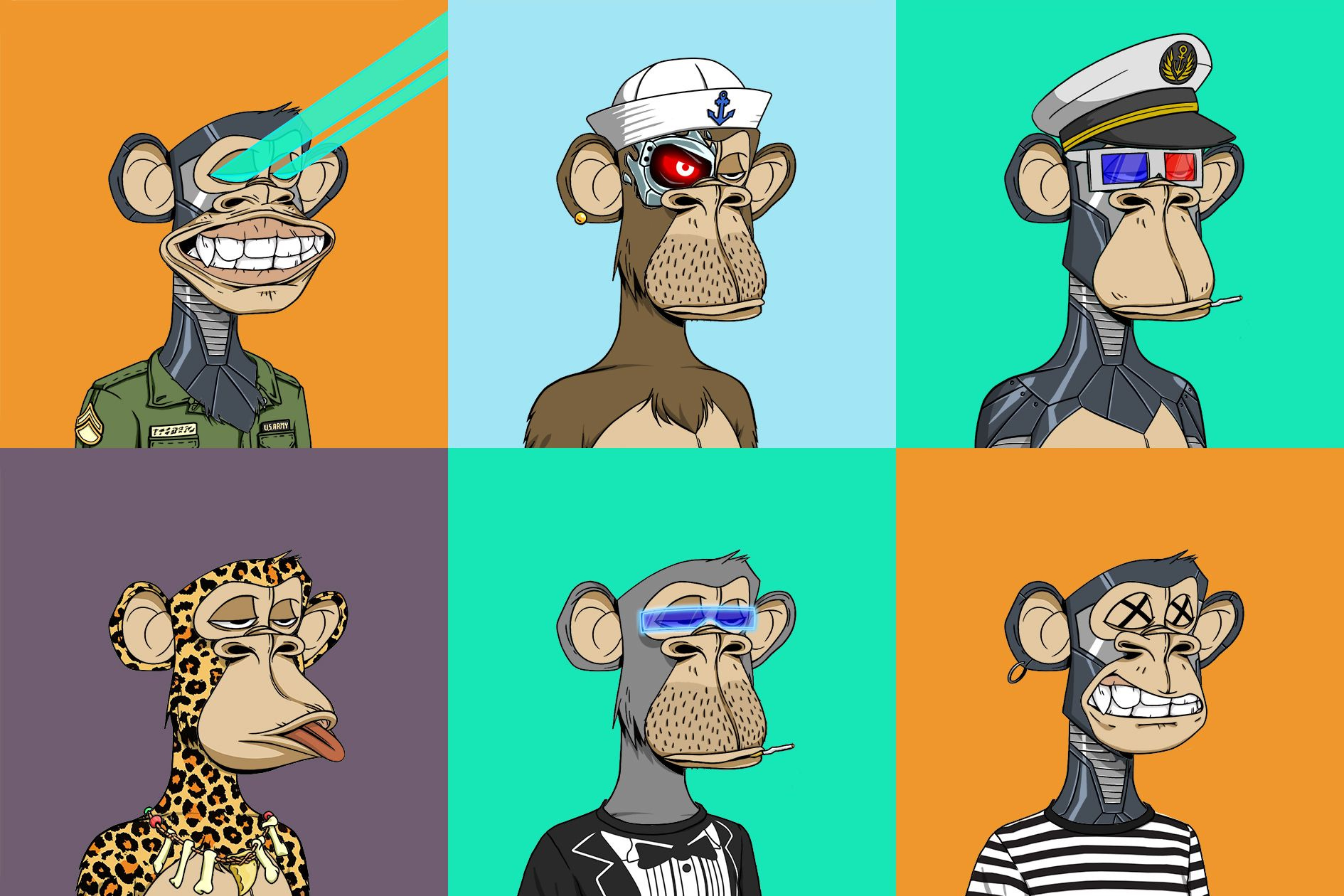
Art and collectibles were the first real-world test of NFTs:
Artists could mint their work as tokens.
Buyers could prove authenticity and ownership.
Royalties could be automated (the artist earns every time it’s resold).
That phase was loud, speculative, and sometimes silly — but it proved the technology works.
Now that the hype cooled, the real use cases are coming into focus.
The real power of NFTs — digital ownership infrastructure
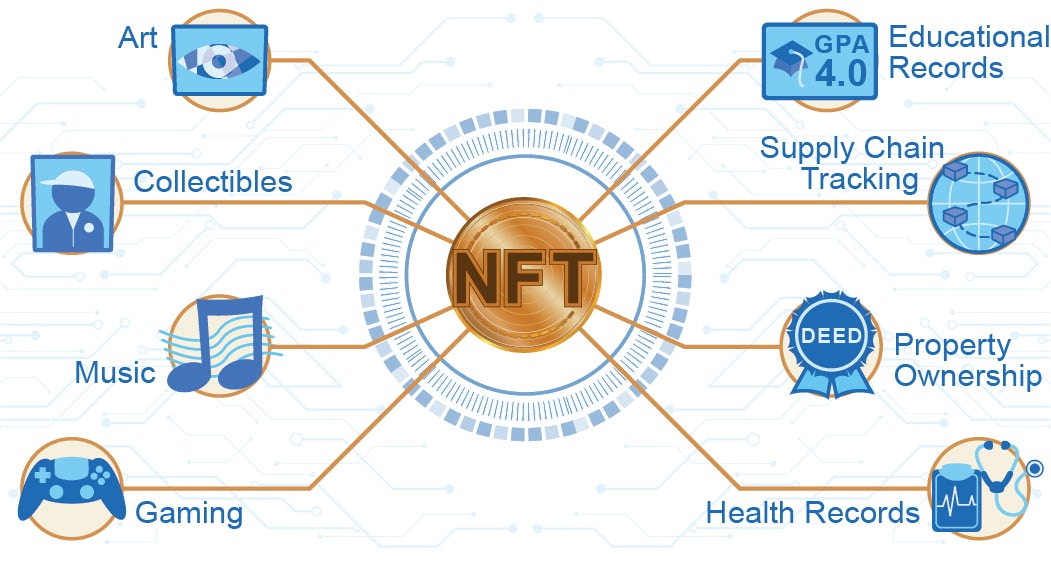
NFTs are really about digital property rights — something the internet never had before.
They let people:
Prove they own something.
Transfer it without intermediaries.
Automate conditions (smart contracts).
Build ecosystems around verified ownership.
That’s the foundation for major industries — not just digital art.
Real-world applications coming next
Let’s break down how NFTs will merge with real industries.
1. Healthcare — the “identity + data” revolution
Healthcare suffers from fragmented records and poor data ownership.
NFTs can fix that by giving patients cryptographic control over their records.
How it could work:
Every patient has a health identity NFT that stores verifiable credentials — vaccination proofs, prescriptions, test results.
The NFT doesn’t store private data directly on-chain (for privacy), but holds encrypted links or access tokens pointing to secure databases.
Patients grant and revoke data access to doctors or insurers via smart contracts.
Auditable trails show who accessed what and when — without revealing the data itself.
Benefits:
True patient-owned data.
Easier portability across hospitals and countries.
Lower admin errors and fraud.
Example projects (in development):
Healthereum, Solve.Care, Medicalchain, and pilot programs where NFTs are used as access keys to health data vaults.
2. Real estate and housing — digital titles and property records
Real estate transactions are slow, paper-heavy, and full of intermediaries.
NFTs can turn property titles into programmable assets.
How it could work:
Each property’s title deed becomes an NFT that contains verified ownership data.
Transfers happen instantly once payment is verified on-chain.
Fractional ownership (selling 10% of a property) becomes possible via splitting the NFT into tokenized shares.
Escrow can be automated — money and title swap simultaneously when conditions are met.
Benefits:
Faster closings.
Tamper-proof title histories.
Reduced fraud and clerical errors.
Global property investment accessibility.
Examples:
Propy already executed blockchain-based home sales using NFT deeds.
Governments (e.g., Sweden, Dubai, Georgia) have tested land registries on blockchains.
3. Supply chains and product authenticity
Every product — from pharmaceuticals to luxury goods — can be linked to an NFT proving origin and authenticity.
How it could work:
Each product batch or serial number is minted as an NFT at the factory.
Every movement (factory → shipper → retailer → buyer) updates the chain of custody on-chain.
Scanning the NFT (QR or NFC chip) lets consumers verify authenticity and origin.
Benefits:
Instant counterfeit detection.
Provenance tracking for recalls or sustainability.
Automated insurance and compliance reporting.
Examples:
VeChain and IBM Food Trust pilot similar systems for food and pharma.
4. Education & professional credentials
Diplomas, certifications, and licenses are perfect NFT use cases.
How it could work:
Universities or medical boards issue verified NFTs as credentials.
Employers or regulators can verify authenticity instantly — no paperwork, no forgery.
Benefits:
Fraud-proof credentials.
Portable, lifelong professional identity.
Automated continuing-education tracking.
Examples:
MIT has issued blockchain diplomas since 2017.
Layer 2 networks like Polygon are being used for digital IDs and certificates.
5. Ticketing, memberships, and access control
NFTs as programmable passes:
A concert ticket that can’t be scalped or faked.
A gym membership that renews automatically.
A digital keycard that unlocks devices or online content.
All built on the same NFT standard — transferable if allowed, revocable if misused.
6. Privacy, security, and compliance challenges
Real-world adoption means NFTs must handle:
Privacy laws (HIPAA, GDPR): store sensitive data off-chain, only proofs on-chain.
Interoperability: different chains and standards must connect seamlessly.
Regulation: clear legal frameworks for property NFTs and identity tokens.
Scams: just like crypto, fake NFT projects or phishing can still occur.
How NFTs connect to the rest of blockchain tech
NFTs rely on:
Smart contracts — code that automates rules (ownership, royalties, transfers).
Oracles — bridges that pull real-world data (like property appraisals or health verifications) onto the blockchain.
Layer 2 solutions — to make transactions cheaper and faster.
Decentralized storage (IPFS, Arweave) — so NFT-linked files can’t just vanish.
Together, they form the digital ownership stack — the infrastructure layer for Web3.
The coming shift — “everything as an NFT”
Over the next decade, expect:
Medical records, deeds, tickets, contracts, and even ID cards to exist as NFTs (or NFT-like credentials).
Governments and enterprises to adopt hybrid models: blockchains for verification, private databases for sensitive data.
Consumer wallets to hold not just coins, but your diplomas, property titles, and memberships — all tokenized.
NFTs will quietly power the next version of the internet, where assets and identity are portable, verifiable, and programmable.
Key takeaways
NFTs = digital ownership certificates, not just digital art.
They’re secured by blockchain and enforce uniqueness, authenticity, and history.
Early hype was just phase one — the real impact will come from infrastructure adoption.
Expect NFTs to underpin identity, health data, real estate, supply chains, and credentials.
The value isn’t the image — it’s the verified proof beneath it.