


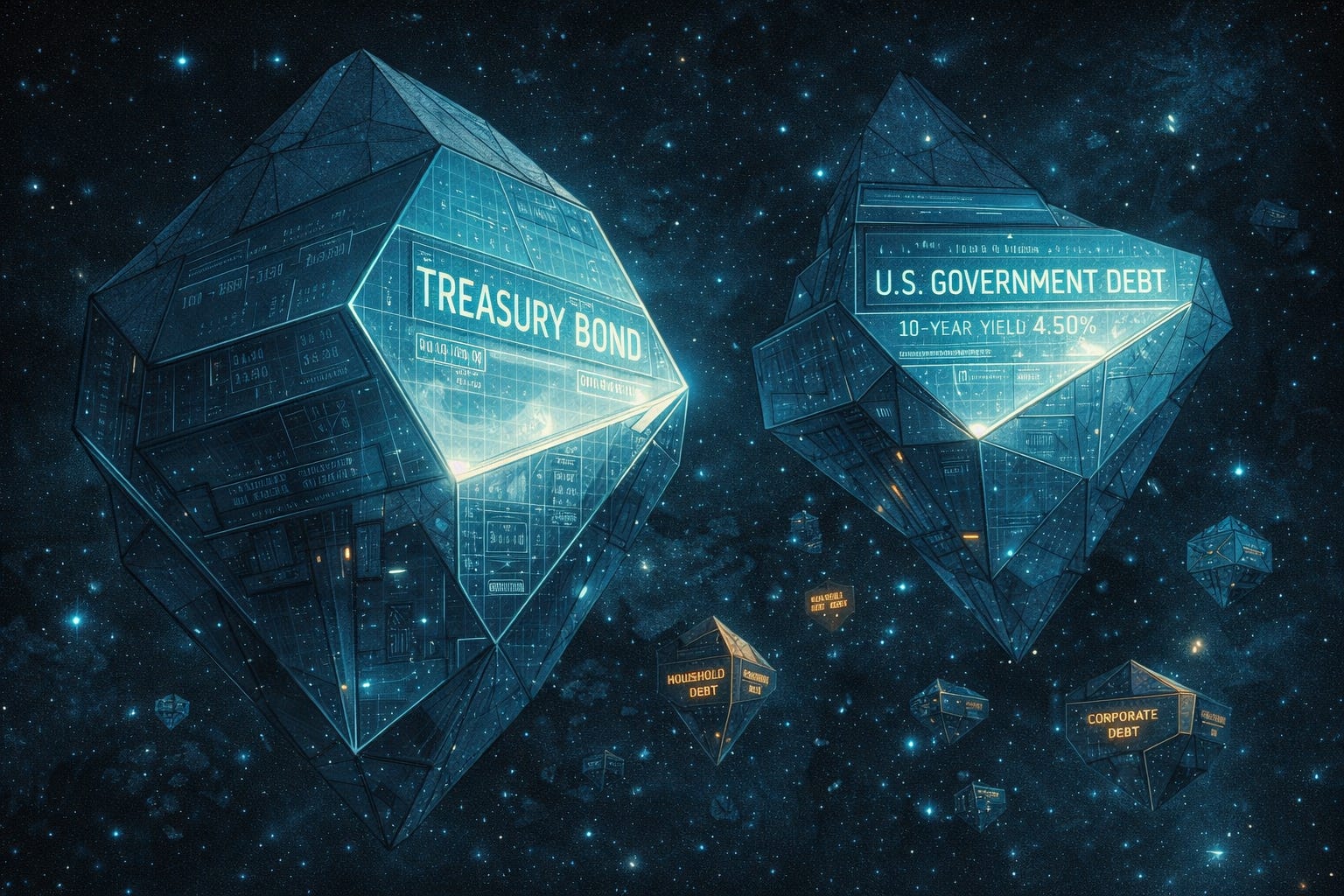
Most arguments about government debt fail before they begin. Not because people are stupid—but because three different concepts get collapsed into one vague moral panic: debt, deficits, and money creation.
They are related. They are not the same. And government debt does not behave like the debt most people are familiar with.
The Category Error at the Center of the Debate
When people hear “debt,” they instinctively map it onto household debt—credit card balances, mortgages, personal insolvency.
That intuition is understandable—and wrong.
Sovereign debt exists in a completely different category. A government that issues debt in its own currency is not constrained the way households or companies are.
That distinction changes everything.
What Government Debt Actually Is
Government debt is a financial instrument, not a liability in the ordinary sense.
When the government issues debt, it is creating a risk-free asset, offering a place for savings to park, and enabling the financial system to function.
Treasuries are not just “borrowed money.” They are collateral, benchmark rates, and settlement instruments. They are the backbone of modern finance.
Why It’s Not Household Debt
Households earn income they don’t control, must repay debt from future earnings, can default involuntarily, and face hard budget constraints.
Governments that issue their own currency define the unit of account, roll debt indefinitely, refinance rather than repay, and cannot be forced to default in nominal terms.
A household must earn money to service debt. A sovereign issues the currency the debt is denominated in.
Same word. Different universe.
Why It’s Not Corporate Debt Either
Corporations borrow to invest, face bankruptcy, depend on revenue, and are judged by solvency.
Governments borrow to manage aggregate demand, operate indefinitely, are judged by inflation and stability, and issue the safest asset in the system.
A company failing is a feature. A sovereign defaulting is a systemic event.
Markets price these differently for a reason.
What a Deficit Actually Is
A deficit is a flow, not a stock. It is simply the gap between government spending and tax receipts over a given period.
Deficits tell you nothing by themselves about sustainability, inflation, or risk. They describe accounting, not outcomes.
A deficit today can increase private sector savings, stabilize demand, or be inflationary. The effect depends on context—not ideology.
Debt Is the Accumulation of Deficits
Debt is a stock. It is the cumulative result of past deficits minus surpluses.
This is where people get tripped up. Large debt numbers feel scary because they are quoted in absolute terms, divorced from interest rates, growth, inflation, and who holds the debt.
A $1 trillion deficit is not inherently dangerous. A $30 trillion debt stock is not inherently catastrophic.
What matters is how the system absorbs it.
Where Money Creation Fits (And Where It Doesn’t)
Money creation is a monetary operation, not a fiscal one.
The government spends, taxes, and issues debt. The central bank manages liquidity, sets interest rates, and buys or sells assets.
Sometimes these actions interact. They are not the same thing.
Issuing debt does not automatically mean printing money.
When Money Actually Gets Created
Money creation occurs when banks extend credit, the central bank expands its balance sheet, or liquidity is injected into the system.
Debt issuance can be absorbed by private investors, pension funds, banks, and foreign holders. No money printing required.
Only when the central bank intervenes directly does monetary expansion occur—and even then, inflation is not automatic.
Why People Collapse All Three Anyway
Because moral language is easier than mechanical thinking.
“Living beyond our means.” “Maxed out credit card.” “Passing debt to our children.”
These metaphors feel intuitive. They are also misleading. They import household logic into a system that does not operate that way.
The Real Constraint Governments Face
Governments are not constrained by solvency. They are constrained by inflation, productive capacity, political legitimacy, and distributional consequences.
The question is never: “Can the government afford this?”
The question is: “What happens to prices, incentives, and stability if it does this?”
The Takeaway
Government debt is not a household balance, a ticking time bomb, or automatic money printing.
Deficits, debt, and money creation are distinct tools operating at different layers of the system.
Collapsing them into one concept leads to bad policy, bad investing, and bad analysis.
If you want to understand modern markets—and modern monetary regimes—you have to stop moralizing the accounting and start understanding the mechanics.