



What cryptocurrency actually is
At its core, cryptocurrency is digital money that runs on open computer networks instead of banks.
It combines three key ideas:
Digital assets — purely electronic, no physical coins.
Cryptography — math that secures transactions and prevents fraud.
Decentralization — no single company or government controls the system.
The first successful cryptocurrency was Bitcoin, launched in 2009 by an anonymous creator (or group) called Satoshi Nakamoto. Bitcoin’s idea was simple but revolutionary:
“What if people could send value online directly, without trusting banks or payment companies?”
Every other cryptocurrency since then (Ethereum, Solana, Cardano, stablecoins, and thousands more) builds on that same foundation.
Why cryptocurrencies exist
Before Bitcoin, online money always required a middleman (PayPal, Visa, or your bank) to keep ledgers, process payments, and prevent “double spending” (the digital version of counterfeiting).
Bitcoin solved that double-spend problem without a central authority, using a public, shared ledger (the blockchain) maintained by thousands of independent computers (called nodes).
This innovation gave birth to the idea of trustless systems — systems that work because of math and code, not because you “trust” a central entity.
That’s the philosophical breakthrough: decentralized trust.
How cryptocurrency works (simplified)
Step 1: The ledger (the blockchain)
A blockchain is just a special kind of database.
Instead of living on one company’s server, it lives on thousands of computers around the world. Everyone has a copy, and they all must agree on what the latest version is.
Each “block” stores a list of transactions. When a block fills up, it’s added (linked) to the chain. Hence: blockchain.
Because the data is public and cryptographically linked, you can’t secretly edit or delete history. That’s what makes it immutable — tamper-proof.
Step 2: Consensus — how everyone agrees on one ledger
Since there’s no central authority, how do thousands of nodes agree on which transactions are valid?
They use consensus mechanisms, the rules of the network.
The two major ones:
Proof of Work (PoW) — Used by Bitcoin.
Miners compete to solve a complex puzzle using computing power; the winner adds the next block and earns rewards (new bitcoins + fees).
It’s energy-intensive but highly secure.Proof of Stake (PoS) — Used by Ethereum (since 2022).
Validators lock up (stake) coins as collateral. They’re chosen to propose and verify blocks based on how much they’ve staked and their track record.
It’s more energy-efficient and faster.
Other variations exist, but all aim to achieve one thing:
global agreement without a central authority.
Step 3: Cryptography — security through math
Two main cryptographic tools power crypto:
Public–private key pairs
Your public key = like your bank account number (it can be shared).
Your private key = like your PIN (never share it).
Anyone can send you crypto using your public key, but only you can spend it using your private key.
Hash functions
These turn any input into a fixed-length digital fingerprint.
They make it nearly impossible to alter blockchain data without detection.
Together, they create digital ownership without needing a central recordkeeper.
Step 4: Tokens and addresses
Each blockchain has its own native token:
Bitcoin’s token: BTC
Ethereum’s token: ETH
Solana’s token: SOL, etc.
Tokens serve different roles:
Pay for network usage (e.g., Ethereum gas fees)
Incentivize security (mining/staking rewards)
Represent assets or rights (e.g., stablecoins, NFTs, governance tokens)
Each wallet has an address, a human-readable form of your public key, where tokens can be sent and stored.
Why cryptocurrencies have value
Cryptocurrencies aren’t backed by gold or governments. Their value comes from utility, scarcity, and network effects, similar to how the internet’s value comes from usage and trust in protocols.
The key drivers:
Scarcity: Bitcoin has a hard cap of 21 million coins — a built-in form of digital scarcity.
Utility: Tokens are needed to use networks (e.g., ETH to run smart contracts).
Security and immutability: The network’s decentralized nature makes it resistant to censorship and tampering.
Adoption: As more people and institutions use a blockchain, demand for its token grows.
Belief: Just as people believe the dollar has value, people believe Bitcoin has value because others will accept it.
The evolution of cryptocurrency
Phase 1: Digital Cash (2009–2013)
Bitcoin was used mainly for peer-to-peer payments and as an experiment in digital scarcity.
Phase 2: Smart Contracts (2015–2020)
Ethereum introduced programmable money (smart contracts) allowing code to execute automatically when conditions are met (“if X happens, do Y”).
That led to entire ecosystems: DeFi (Decentralized Finance), NFTs, and DAOs.
Phase 3: Mainstream Adoption (2020–today)
Now crypto touches payments, art, gaming, lending, and even national-level projects.
Large financial institutions offer crypto custody, ETFs, and derivatives. Governments study central bank digital currencies (CBDCs).
Cryptocurrency has gone from an internet experiment to a recognized — though volatile — asset class.
Strengths and advantages
Global access: Anyone with the internet can send or receive funds — no bank account required.
Open and transparent: The blockchain is public; anyone can verify transactions.
Censorship resistance: No central authority can block or reverse transactions.
Programmability: Developers can build applications (smart contracts) that handle money automatically.
Inflation hedge: Some see Bitcoin as “digital gold” — limited supply, outside central bank control.
Limitations and criticisms
Volatility: Prices can swing wildly.
Scalability: Some networks (like Bitcoin) are slower and more expensive for small transactions.
Energy use: Proof of Work networks consume a lot of electricity.
Security for users: If you lose your private key or fall for scams, there’s no recovery hotline.
Regulatory uncertainty: Governments are still defining how crypto fits into existing laws.
Speculation and hype: Many projects fail or are outright scams. Filtering signal from noise is essential.
Why crypto has had success (despite everything)
Cryptocurrency succeeded where past digital money experiments failed because it combined incentives, technology, and ideology in the right way.
Incentive alignment: Miners and validators earn rewards, so they’re motivated to keep the system honest.
Open participation: Anyone can join, it’s not a closed club of banks.
Technological resilience: Blockchains are hard to shut down. They’re global, redundant, and cryptographically secure.
Ideological appeal: For many, crypto represents financial independence, privacy, and freedom from intermediaries.
Network effects: Each new user or developer makes the ecosystem more valuable and useful.
Major categories of cryptocurrency
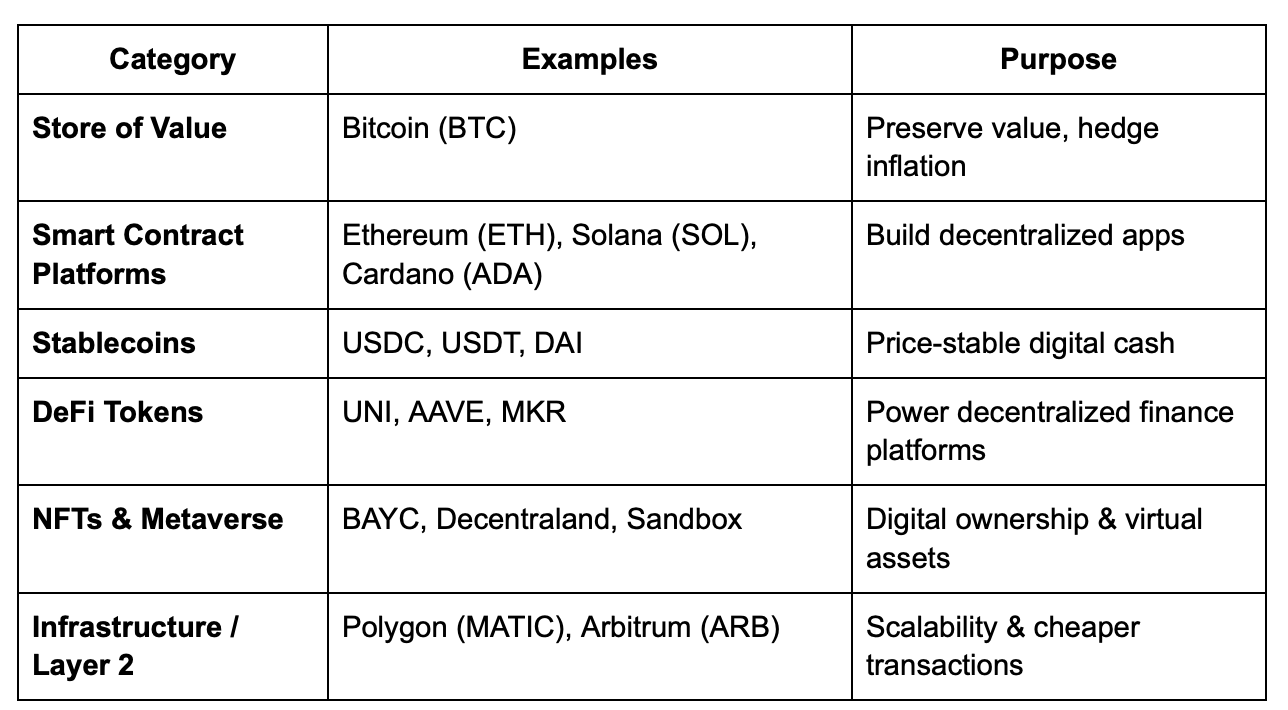
The future of cryptocurrency
The next decade will focus on scalability, regulation, and real-world integration.
Expect:
Better user experiences (simpler wallets, safer custody).
Mainstream finance adoption (ETFs, on-chain treasuries, tokenized assets).
Governments issuing CBDCs, coexisting with decentralized crypto.
Energy-efficient networks dominating new designs (Proof of Stake, Layer 2).
More regulation and compliance tools to bridge crypto with traditional finance.
Crypto isn’t replacing the financial system, it’s rewiring it from the bottom up.
Key takeaways
Cryptocurrency = digital, decentralized money secured by cryptography.
Blockchain = the shared ledger that makes it all work.
Bitcoin solved digital scarcity; Ethereum introduced programmable money.
Success comes from open participation + strong incentives + decentralization.
It’s volatile, complex, and still evolving — but it’s not a fad. It’s a foundational new technology for value exchange.