


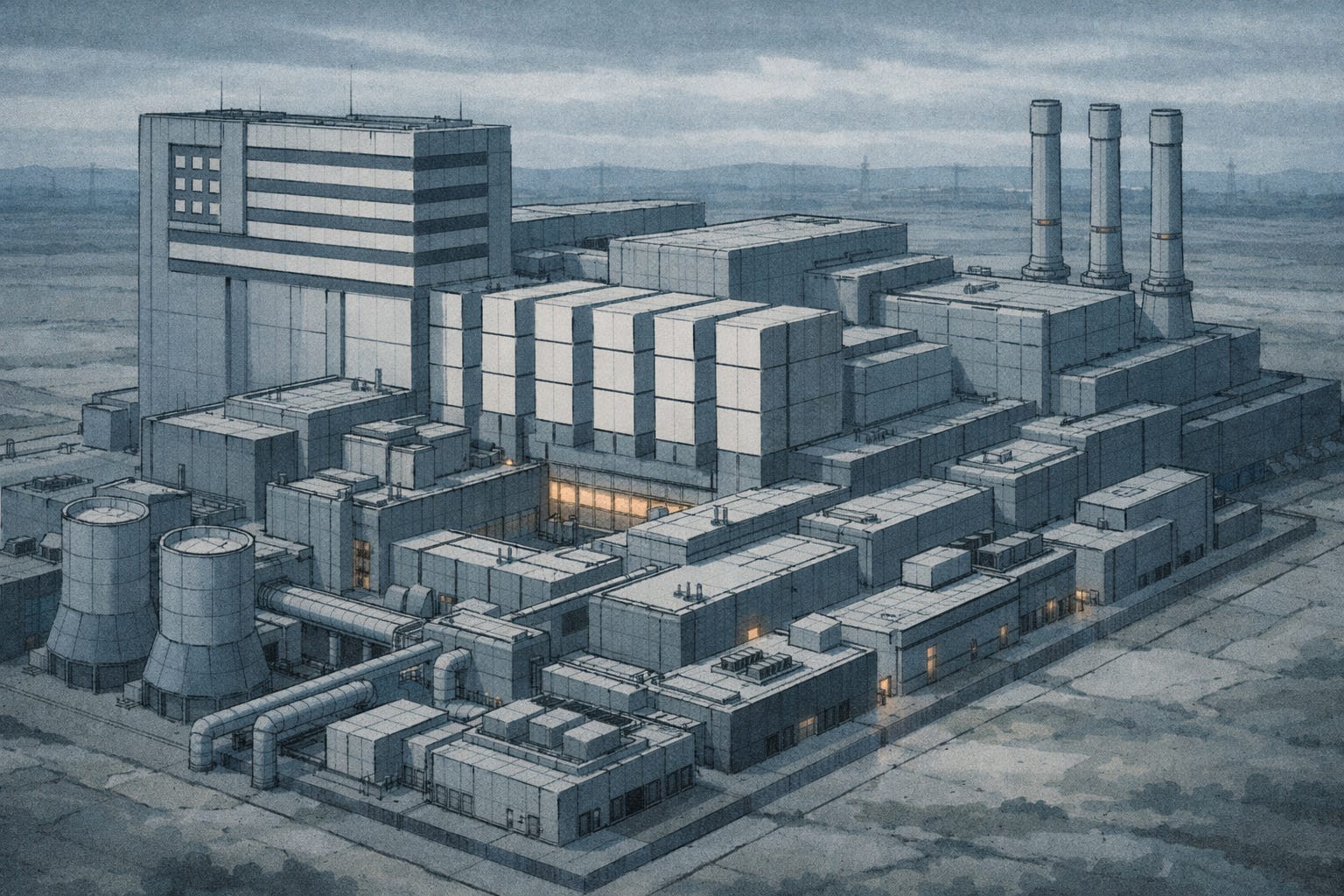
This is not a prediction. It is a framework for understanding potential change in valuations — one that may never resolve, and is more useful as a lens than a trade.
There is a version of the Intel thesis that has nothing to do with Intel.
It does not require 18A to beat TSMC N2. It does not require Pat Gelsinger’s ghost to be exorcised from the org chart, or a turnaround that actually turns. It does not require Intel to win in any conventional market sense. It requires only one thing: for the world to decide that “who makes your chips” is a question with a national security answer.
That decision is already being made.
The Old Moat Is Dead
For most of the semiconductor era, competitive advantage meant process leadership. Smaller nodes, better yields, faster clocks. The company closest to the physics won. TSMC won. ASML became a monopoly on the equipment to get there. Intel, which invented this game, forgot how to play it.
But process leadership assumed a stable world — one where capital flowed freely, supply chains were optimized for efficiency, and the nationality of your fab was an irrelevant footnote. That world is gone. The deglobalization that began with tariffs and accelerated through COVID is now structural. The question is no longer just “which fab is fastest” but “which fab is accessible under adversarial conditions.”
This is a regime change. And regime changes reassign value in ways that look absurd until they look obvious.
Sovereignty as the New Moat
The United States government took a partial stake in Intel. This is not a footnote. The CHIPS Act is not a subsidy — it is a declaration that domestic semiconductor capacity is a strategic asset, and Intel is its primary vessel. The government does not invest in things it intends to let fail.
The reshoring mandate that is quietly restructuring American industrial policy requires a full semiconductor supply chain on U.S. soil. Not a partial one. Not a Taiwan-dependent one with a domestic finishing step bolted on. A real one. Intel is the only company positioned to anchor that chain. TSMC’s Arizona fabs are a hedge. Intel is the thesis.
This creates a category of competitive advantage that has no historical analog in the semiconductor industry: political indispensability. Not the kind that lobbying buys. The kind that geography and timing and critical infrastructure lock in.
The Floor That Market Logic Cannot See
Markets price Intel as a failing legacy chipmaker losing ground to AMD, Nvidia, and TSMC. That framing is accurate and also incomplete. It prices the operational reality without pricing the geopolitical floor.
Consider the asymmetry: if Intel’s 18A node delivers and the foundry business gains traction with a hyperscaler anchor customer, the upside reprices the entire company. If 18A slips again, the government’s strategic interest does not evaporate — it intensifies. The worse Intel performs on merit, the more the state has to intervene to ensure it survives. The floor is not Intel’s earnings. The floor is the Pentagon’s risk tolerance for TSMC Taiwan exposure.
This is not unique in history. Strategic industries have always attracted state support that distorts normal market outcomes. Steel. Airlines. Defense contractors. The semiconductor industry just convinced itself it was different because it was global. It was never global in any durable sense. It was deferred reckoning.
What Actually Needs to Be True
The full Intel bull case — 18A competitive, hyperscaler anchor customer, AI accelerator traction, NIL or alternative lithography breaking ASML’s grip, chiplet architecture leveling the node race — is a compounding of low-probability events. Most of it probably won’t happen on schedule.
But the thesis does not require all of it. It requires the geopolitical conditions to remain true (high probability), Intel to not catastrophically self-destruct (moderate probability), and one of the technical milestones to land (possible). That conditional scenario — tailwinds carry Intel while it slowly repairs itself — is the actual bet.
The market is pricing the merit story. The sovereign story is underpriced because it requires a mental model that most equity analysts were never trained to apply to a chip company.
The most interesting thing about the Intel thesis is that it is an anti-meritocracy argument. Intel does not need to earn its relevance. It needs the system to need it. In a deglobalizing world, being the only domestically controlled advanced fab on American soil is a moat that no competitor can build around — because the moat is not technology. It is geography, policy, and the slow realization that efficiency was always a fair-weather virtue.