


For most of the industrial age, specialization was survival.
You picked a lane. You mastered it. You traded depth for security.
The lawyer did not code. The engineer did not trade. The theologian did not build factories. Society rewarded narrow excellence because that is what the economic structure required.
Specialization worked. But it worked under specific conditions.
Those conditions are disappearing.
Specialization Was an Economic Optimization
Specialization was not a moral achievement. It was not about human flourishing. It was about efficiency.
Factories required it. Production lines needed workers who could execute the same task repeatedly. You did not need to understand the entire system. You needed to operate your station.
Universities required it. As knowledge expanded, no single person could master everything. Departments formed. Disciplines fragmented. You became an expert in one narrow domain because that is what institutions could credential and employers could evaluate.
Corporations required it. Hierarchies depended on defined roles. Job descriptions. Career ladders. You were hired for a specific skill set and you stayed in your lane.
This made sense when information was scarce, when coordination was expensive, and when human labor executed most tasks.
But all three of those constraints are breaking down.
Information is no longer scarce. Coordination is no longer expensive. And human labor is no longer the only option for execution.
The economic justification for narrow specialization is eroding.
The Internet Collapsed the Gatekeepers
The first rupture was the internet.
For the first time in history, expertise became directly observable. You no longer needed institutional permission to learn. You did not need to attend the right university or work at the right firm to access insight.
You could follow technologists, economists, historians, scientists, and investors in the same feed. You could watch how they thought through problems in real time.
This was not just about access to information. It was about access to reasoning.
When you regularly observe how experts in different fields think, something shifts. You start recognizing patterns that cross domains.
You see how a technologist reasons about systems and apply that framework to markets. You see how a historian identifies cycles and apply that lens to policy. You see how an economist models incentives and apply that structure to business strategy.
You begin building a latticework of mental models instead of a single silo.
This is not dilettantism. It is pattern recognition at a higher level of abstraction.
Specialization held power because it controlled access to scarce knowledge. The internet made knowledge abundant.
What became scarce was synthesis.
AI Changed the Game Completely
The internet gave you access to expertise. AI gives you access to execution.
This is the structural difference that changes everything.
Specialists used to hold power because they controlled procedural knowledge. They knew how to do the thing. The thing took time. The thing required experience. The thing could not be shortcut.
Now you can prompt a language model to explain advanced concepts, generate working code, draft analysis, model scenarios, and surface connections between ideas you did not know existed.
You no longer need to be the best coder to build software. You need taste and judgment about what to build.
You no longer need to be a credentialed economist to understand debt dynamics. You need the ability to ask the right questions and filter signal from noise.
You no longer need to spend ten years mastering a narrow technical skill. You need to understand what the tools can do and how to direct them.
The bottleneck shifted from acquiring information to interpreting and orchestrating it.
And that shift changes the value equation completely.
What Gets Automated
Here is the pattern that matters.
If a task is rule-based, repeatable, bounded by clear parameters, and structured in language, it is on the path to automation.
The more specialized your work is—the more it depends on executing known procedures within a defined domain—the easier it becomes to model.
A tax accountant who applies the same regulations year after year is doing work that AI can increasingly handle.
A radiologist who identifies patterns in medical imaging is doing work that computer vision is getting better at.
A paralegal who reviews contracts for standard clauses is doing work that large language models can process faster.
These are not low-skill jobs. They are high-skill, highly specialized jobs. And that specialization is exactly what makes them automatable.
Because specialization means operating within known rules. And rules can be encoded.
What is harder to automate is judgment across contexts. Knowing when to apply which framework. Recognizing when a problem in one domain resembles a problem in another. Synthesizing information from multiple sources that do not obviously connect.
That is what generalism enables.
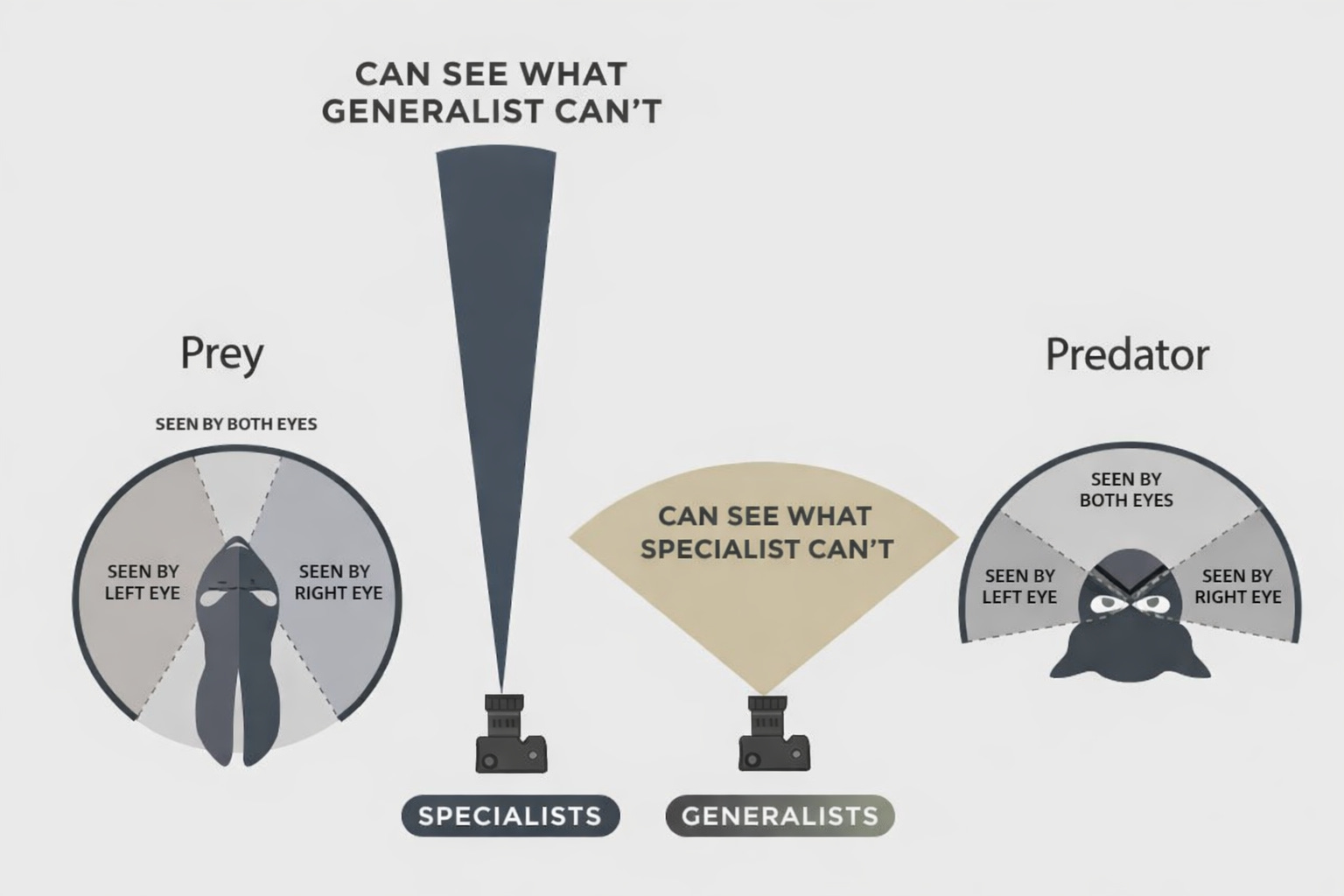
The generalist does not know more than the specialist in any single domain. But the generalist can operate between domains. And that is becoming more valuable.
The New Skill Stack
The modern renaissance man is not someone who “knows everything.” That is a useless frame.
He is someone who can synthesize across domains, recognize structural patterns, filter signal from noise, and direct tools rather than compete with them.
He understands how systems work, not just how one piece of the system works.

Someone with a finance background who understands AI can build tools that automate analysis in ways traditional firms cannot. Someone with a legal background who understands automation can structure agreements that eliminate entire categories of overhead. Someone with a medical background who understands data can identify patterns in patient outcomes that specialists miss.
These are not hypothetical examples. These are businesses being built right now by people who are not the best in any single domain but who can see across domains.
The edge is at the intersection.
Finance + AI. Law + automation. Medicine + data science. Education + adaptive systems.
When the center of each domain is being automated, value migrates to the edges where domains overlap.
Institutions Are Lagging
Here is the tension.
The economy is rewarding generalism. But institutions are still optimized for specialization.
Universities still operate as if depth in a single field is the goal. Degree programs are siloed. Departments compete for resources. Interdisciplinary work is praised in theory and ignored in practice.
Corporations still hire for credentials and narrow expertise. Job postings list requirements that assume you spent years in one vertical. Promotion tracks reward staying in your lane.
Professional licensing still validates narrow competence. Certifications. Bar exams. Board certifications. These exist to ensure you can operate within a specific bounded domain.
But the market is moving.
The companies being built today are lean, cross-functional, and fast. They do not need specialists who take six months to onboard. They need people who can learn quickly, operate across tools, and make decisions without perfect information.
The mismatch creates opportunity for people who recognize it and risk for people who do not.
If you are optimizing for what institutions reward, you may be optimizing for a structure that is losing relevance.
Why Now
This is not a historical curiosity. This is happening now.
AI capability is improving faster than institutions can adapt. Tools that did not exist two years ago are already embedded in workflows. Entire categories of work are being restructured.
The half-life of specialized knowledge is shortening. What you learned five years ago may be partially obsolete. What you learn today may be automated in two years.
The people who thrive will not be the most technically deep in a single vertical. They will be the most adaptive across shifting terrain.
This is not motivational language. This is structural observation.
In stable environments, depth wins. You go deep, you stay deep, you compound expertise over decades.
In unstable environments, breadth wins. The ability to pivot, reframe, and synthesize across domains becomes more valuable than mastery of any single domain.
We are not in a stable environment.
What Generalism Actually Requires
Generalism is not about being scattered. It is not about reading widely and calling yourself a polymath.
It requires building real capabilities across domains.
Structural thinking. Understanding how systems interact. Seeing feedback loops. Recognizing second-order effects. Knowing that a change in energy policy affects manufacturing which affects employment which affects politics.
Incentive mapping. Knowing what different actors optimize for. Why institutions behave the way they do. Where misalignments create opportunity. Understanding that a hospital optimizes for different outcomes than an insurance company, and both optimize for different outcomes than a patient.
Signal filtering. Distinguishing insight from noise. Knowing which sources are worth attention and which are performing. Recognizing when someone is reasoning from first principles versus repeating consensus.
Judgment under uncertainty. Making decisions without perfect information. Acting before the optimal path is clear. Iterating faster than consensus requires.
These are not skills you acquire in a classroom. They develop through exposure to multiple domains and practice operating at the intersections.
The people building these capabilities are not doing it for aesthetic reasons. They are doing it because the economy is rewarding it.
The Scarcity Flip
When information was scarce, specialists held power. They controlled access to knowledge that others could not easily obtain.
Now information is abundant. AI can generate explanations, code, analysis, and models on demand.
What became scarce is not information. It is judgment.
Knowing what to build. What problems are worth solving. What questions are worth asking. What information is worth trusting.
Specialists still have value when they operate at the frontier of their field. The researcher pushing the boundary of what is known. The surgeon handling the rare case. The engineer solving the novel problem.
But routine specialist work—applying known frameworks to standard problems—is being compressed.
The generalist who can direct AI tools, synthesize across domains, and make judgment calls about what matters is becoming more valuable than the specialist who executes procedures within a narrow lane.
That is the flip.
And it is not reversing.
The Real Risk
The real risk is not that AI replaces you.
The real risk is that you remain optimized for a world that no longer exists.
A world where credentials gate access. Where institutions define legitimacy. Where specialization guarantees security.
That world is fading.
It has not disappeared. Credentials still matter in some contexts. Institutions still exist. Specialization still has value in certain domains.
But the direction of travel is clear.
Economic returns are shifting toward people who can operate fluidly across domains, synthesize faster than institutions can, and make decisions in environments where the rules are still being written.
If you are still thinking in terms of “picking a major” or “choosing a career” as a thirty-year commitment, you are operating with assumptions that no longer hold.
The half-life of that decision is shrinking.
What the Renaissance Actually Was
The Renaissance was not about polymaths deciding to be interesting.
It was a structural collapse of information monopoly.
The printing press broke the Church’s control over knowledge. Texts that were locked in monasteries became accessible. Ideas spread faster than institutions could regulate them.
The result was not just art and science. It was a reorganization of who got to participate in intellectual production.
We are living through another collapse.
The printing press is digital. The workshops are virtual. The gatekeepers are losing control.
The question is not whether this creates opportunity. It does.
The question is whether you are structurally positioned to recognize it.
Not whether it is fair. Not whether you wish it were different.
Whether you are capable of adapting to the terrain that is emerging while others remain optimized for the terrain that is disappearing.
That is the choice.
Not between optimism and pessimism. Between adaptation and rigidity.
The modern renaissance man is not an aesthetic identity. It is a structural response to a changing environment.
And the environment is changing whether you participate or not.