


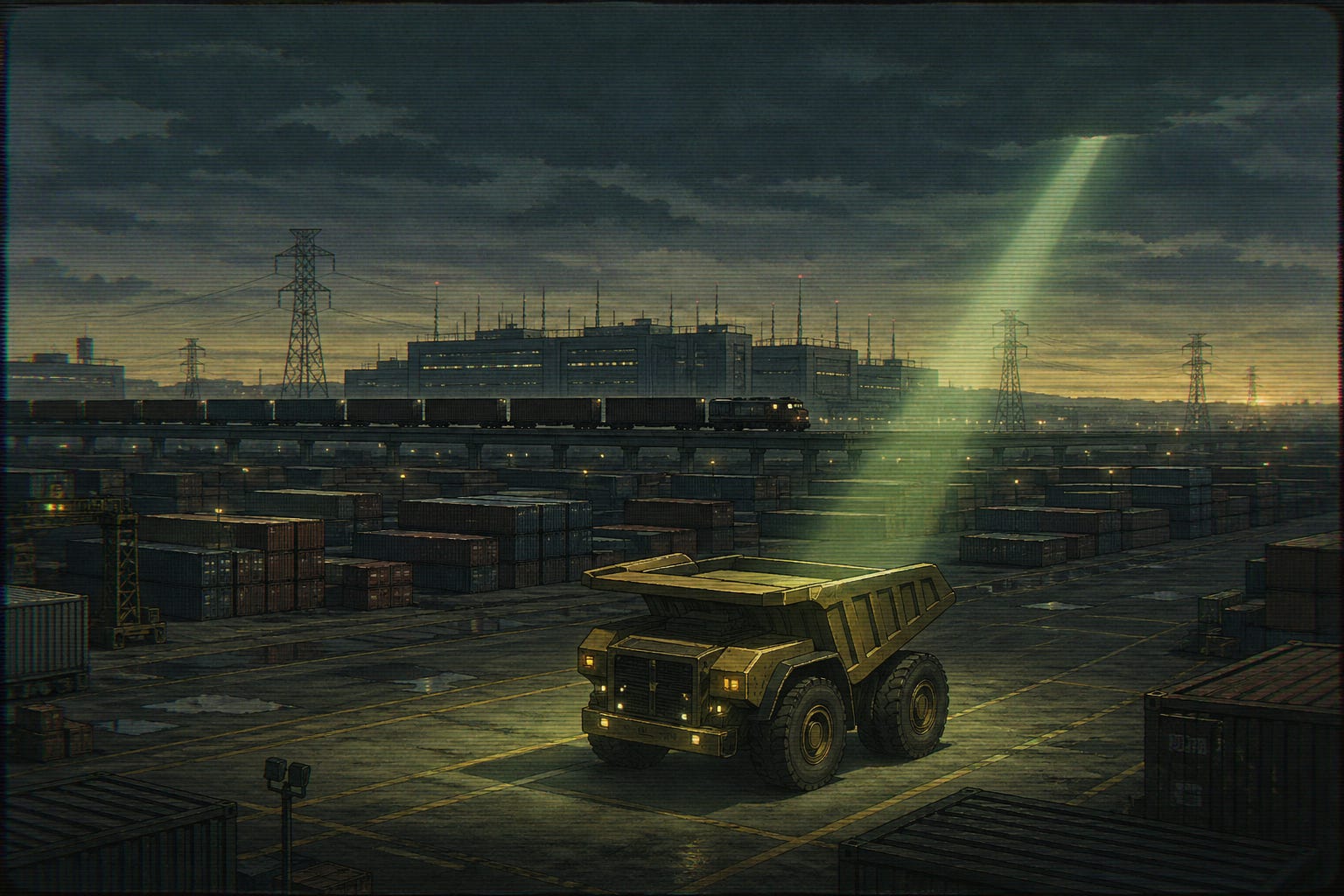
The data center buildout is priced in. It has been for about a year.
You can argue about which hyperscaler captures the most workload, which chip architecture wins the inference race, which power utility gets a regulated rate base bump out of the next gigawatt of demand. Those are real arguments. They are also crowded arguments. Every macro Substack, every sell-side desk, every retail thread has been working that side of the trade since the back half of 2024. The information edge there is gone.
The frame I want to propose is different. The data center is the input layer of a paradigm shift. The interesting question — the question with actual asymmetry left in it — is what happens at the output layer. Not who sells the picks and shovels. Who outlives the gold rush.
Every company in the market right now is being asked, implicitly or explicitly, the same question: does AI compound inside this company, or does it replace what this company sells? The answer determines whether the moat thickens or dissolves. I’m calling this Sink or Swim. This piece is the Swim side. The Sink side comes next.
The filter
Most “AI beneficiaries” lists are too generous. Anyone who runs a Copilot pilot makes the cut. That’s noise. The companies that actually compound under AI deployment — the ones where the technology shows up in audited segment margins five years from now, not in slide decks — share three structural traits.
One: physical scale that’s hard to replicate. Software moats compress. Physical moats — fleets, networks, dealer footprints, real estate, equipment installed bases — don’t compress on a software timeline. AI applied to a hard-to-replicate physical asset compounds. AI applied to a software product gets competed away by the next foundation model release.
Two: operational complexity where AI eats real cost. The bigger the gap between optimal operations and actual operations, the more AI has to feed on. A company running a single warehouse doesn’t have much room. A company running a continental network of trucks, rails, ports, distribution centers, maintenance crews, and dispatch decisions has enormous room. The complexity is the opportunity.
Three: a distribution or customer moat that doesn’t depend on being the AI innovator. This is the one that filters out most of the candidate list. A lot of companies will use AI well. Few of them will capture the value. The ones that capture it have customers who can’t easily leave — because the relationship is built on physical footprint, regulated rights-of-way, certified service networks, or installed-base lock-in that AI doesn’t touch.
If a company hits all three, AI compounds inside it. If it hits two, the story is a coin flip. If it hits one or zero, the company is on the other side of this essay — the Sink side — and we’ll deal with it later.
The anchor: Caterpillar
CAT is the cleanest expression of the thesis I can find, and it’s instructive because the market is currently treating it like an industrial cyclical that’s having a margin year. That framing isn’t wrong on a one-year view. It’s catastrophically wrong on a five-year view, and the gap between those two views is the trade.
Start with the deployment numbers, because the numbers are the part that separates this from a story stock.
CAT ended 2024 with 690 autonomous haul trucks in operation. They ended 2025 with 827. They’ve publicly committed to over 2,000 by 2030 — a tripling in five years — and the company has won eight of the last nine greenfield autonomous mining contracts. Cumulative tonnage hauled autonomously crossed five billion tonnes. The autonomous fleet has logged more than 200 million kilometers of operation, more than twice the experience of any automobile manufacturer’s autonomous program. Productivity advantage versus staffed fleets runs around 20 percent. Lost-time injuries on autonomous sites are zero.
This is not a pilot program. This is a deployed product with a decade-plus operating record, expanding into adjacent markets — aggregates, smaller mines under fifteen trucks, oil sands — that were previously uneconomic. The TAM is not the existing autonomous fleet. The TAM is every haul truck in every extraction operation on the planet, and CAT is the only company with a deployed-at-scale system that customers are choosing in greenfield bids at a 9-to-1 rate.
Now layer the second business. CAT’s Energy & Transportation segment crossed $10 billion in power generation sales in 2025, growing more than 30 percent year-over-year, driven primarily by reciprocating engines for data center backup and prime power. The company is doubling large engine capacity and more than doubling industrial gas turbine capacity by 2030. Backlog hit a record $51 billion at year-end 2025, up 71 percent year-over-year.
So you have one segment selling the equipment that gets installed during the buildout (gensets, turbines, backup power for data centers), and another segment deploying AI inside its own customer base in a way that expands the addressable market for its core machinery. Both segments are growing. Both have multi-year backlogs. Both have structural tailwinds that don’t depend on the AI training cycle continuing at its current pace.
And here’s the part the market is missing: 2025 was a margin compression year. Resource Industries operating margin dropped from 20.45% in 2024 to 15.94% in 2025. Construction Industries dropped from 24.22% to 18.66%. Tariffs, unfavorable price realization, manufacturing cost pressure. The stock got punished accordingly. Adjusted full-year operating margin came in at 17.2%, well below the recent 20%+ norm.
This is the buy point, not the sell signal. The autonomy fleet is tripling over the next five years on a fixed software development cost base. The power generation business is in the middle of a capacity doubling that hasn’t shown up in revenue yet because the engines aren’t built. The 71 percent backlog growth is telling you what the next four quarters of revenue look like. The current margin profile is the compressed one. The expanded one is what you get when the autonomy software gets sold across a fleet 3x its current size, against the same engineering cost. That’s the operating leverage the cyclical-industrial framing isn’t pricing.
CAT passes the three-part test cleanly. Physical scale: a 150-dealer global network with 2,800 service facilities across 190 countries, which is functionally impossible to replicate. Operational complexity: every customer site is a multi-decade relationship involving equipment, parts, service, financing, and increasingly software. Distribution moat: customers don’t leave CAT for a competing autonomy stack because the autonomy stack is welded to the dealer network and the parts supply chain. The AI is the wedge that deepens the moat, not a moat in itself.
This is what a Swim company looks like.
The recursive loop: freight
The freight argument is more abstract because freight is a sector, not a company, and the right way to express the thesis is at the sector level. The mechanics, though, are the cleanest illustration of the compounding I’m trying to point at.
Consider what a freight network actually does during the AI buildout.
Stage one: the freight network moves the buildout. Every transformer, every rack, every cooling unit, every length of fiber, every ASML photolithography machine, every truck of concrete for the slab pour, every shipment of GPUs from a packaging facility in Taiwan to a hyperscaler campus in Virginia — all of it moves through trucks, rails, and ports. The freight network is not adjacent to the buildout. The freight network is the buildout’s circulatory system. Every dollar of capex turns into multiple dollars of freight revenue along the way, because nothing in this economy moves by itself.
Stage two: the AI that gets trained inside the data centers the freight network helped build starts being deployed against the freight network’s own operations. Predictive maintenance on locomotives. AI-assisted dispatch on rail networks. Crew scheduling optimization. Yard management. Dynamic pricing on intermodal lanes. Driver assistance and eventually autonomy on long-haul trucking. Route optimization on last-mile. Each of these is a direct attack on the largest expense lines in the freight P&L — labor, fuel, asset utilization, dwell time.
Class I railroads have been running at operating ratios in the 60% range under Precision Scheduled Railroading. Union Pacific reported a 60.7% operating ratio in Q1 2025, the best in the industry. The PSR playbook squeezed a generation of efficiency out of these networks already. The next leg — the AI leg — is targeting the residual inefficiency PSR couldn’t reach. It’s the difference between scheduling trains on a spreadsheet and scheduling them with a model that’s run a hundred million simulations against weather, demand, crew availability, and equipment status.
Stage three is the compounding. The AI deployment that came out of the data centers the freight network helped build ends up reducing the freight network’s own operating costs, freeing capex for further network investment, which moves more freight, which trains more AI, which gets deployed back. The loop closes inside the same set of companies. They are simultaneously a customer of the buildout, a delivery mechanism for the buildout, and a beneficiary of the buildout’s output.
Few sectors have this property. Freight is one of them. Mining is another (CAT is just one node in that loop). Energy infrastructure is a third. The pattern is: physical networks that move or process the inputs to the AI economy, which then become the highest-leverage targets for the AI economy’s outputs.
The investable expressions are the Class I rails (UP, CSX, NSC, CP), the LTL operators with the most operational complexity to optimize against (the Old Dominion-style operators), the intermodal and brokerage layer where AI dispatch eats the most fragmented margins, and — over a longer horizon — the autonomous trucking layer when it stops being a story and starts being a deployment number. I’m not endorsing specific names in this piece. I’m pointing at the structural pattern. The names need their own work.
What I will say is that freight, in aggregate, is the most under-appreciated leg of the post-buildout thesis, because the consensus framing of freight is still “boring industrial cyclical exposed to GDP.” That framing was correct for forty years. It is becoming wrong in front of us, and the names will re-rate when the operating ratios start compressing past what PSR alone could deliver.
The honest stress test
I owe you the version where this is wrong.
The Swim thesis depends on AI deployment actually flowing through to operating margins inside non-tech companies. The empirical evidence on that is still thinner than the discourse implies. McKinsey-style productivity studies are not the same thing as audited segment margin expansion. There is a real risk that the deployment cycle takes longer than the patience cycle — that companies invest heavily in AI integration through 2026 and 2027, the margins stay compressed under integration costs, and the market loses faith in the thesis right before the operating leverage shows up. That’s the canonical late-cycle disappointment pattern, and a version of it is plausible here.
The filter against that risk is exactly what I led with: deployment that’s already shown up in the numbers, not deployment that’s coming. CAT works as a thesis specifically because the autonomous fleet has a decade of operating history and a quantified productivity advantage that’s been audited by customers buying more of it at a 9-to-1 rate in greenfield bids. That’s not a forward story. That’s a back-tested deployment with a forward expansion curve. The freight thesis has the operating ratio history under PSR as the prior, and the AI dispatch deployment is incremental on top of a known base.
When you’re hunting for the next Swim name, the test is: where is the deployment already happening and showing up in the numbers, versus where is it still a forward-looking story? The story names are where the disappointments will cluster. The deployment names are where the compounding lives.
What this means
Three things, if you accept the frame.
First, the AI trade is not over because the data center trade is over. It has barely started in the place where it matters most, which is the rest of the economy. The buildout takes two years. The compounding takes a decade.
Second, the screen for finding Swim companies is structural, not narrative. Physical scale, operational complexity, distribution moat. If a company doesn’t hit all three, it doesn’t matter how good the AI strategy slide deck is.
Third — and this is the part I’ll develop in Part II — the same lens that identifies Swim companies identifies Sink companies. A moat built on switching costs without ongoing innovation has a half-life that begins the moment a new computing paradigm offers users an off-ramp. Some of the names that consensus considers “quality compounders” are actually on the wrong side of this question. We’ll get to them.
For now: stop looking at the buildout. Start looking at what the buildout makes possible.
That’s where the next decade is.
Part II — the Sink side — will run next week. Subscribe if you want it in your inbox.