


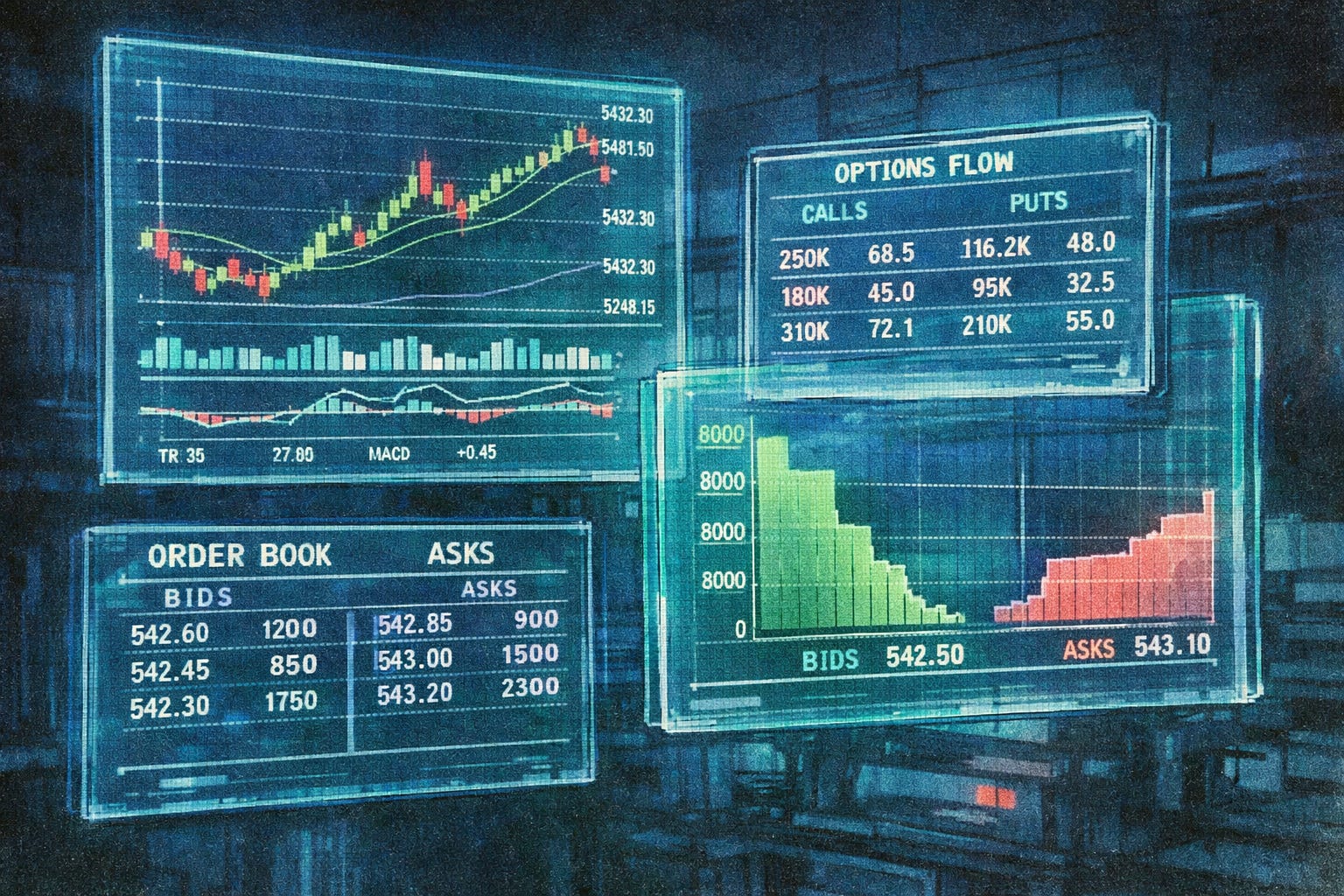
Most people assume prices are discovered where they see prices—charts, tickers, headlines, earnings calls, vibes. That hasn’t been true for a long time.
Price discovery is not a philosophical process. It’s mechanical. It happens wherever marginal trades, leverage, and information asymmetry intersect. And today, that is very rarely the place retail investors are looking.
What Price Discovery Actually Means
Price discovery is the process by which markets determine the current clearing price of an asset. Not the “fair” price. Not the “intrinsic” value. Just the price at which the next buyer and seller agree to transact.
The key word is marginal.
Prices move based on the last trade that clears supply and demand. Not on the average belief, not on consensus narratives, and not on how many people “feel” bullish or bearish. This is why markets can move violently on seemingly small flows.
It’s also why understanding market structure matters more than ever. The mechanics of how trades are executed, where liquidity pools exist, and which participants are forced to transact all shape prices in ways that traditional analysis often misses.
Where People Think Price Discovery Happens
Most investors intuitively believe price discovery happens in stock exchanges, earnings reports, economic data releases, retail buying and selling, and news-driven reactions.
These inputs matter, but mostly as inputs into other markets—not as the primary site of price setting. By the time a narrative reaches the front page, price discovery has usually already happened elsewhere. The visible market activity is often the echo, not the origin.
Where Price Discovery Actually Happens Now
1. Derivatives Markets (Futures & Options)
Futures and options dominate modern price discovery because they allow leverage, directional expression, hedging at scale, and rapid repositioning.
Large institutions do not wait to buy or sell the underlying asset to express a view. They use derivatives to set the direction first. Spot markets often follow. This is why equity prices can move before cash market volume meaningfully increases.
The tail wags the dog more than most investors realize. A relatively small position in the derivatives market can signal—or force—a much larger move in the underlying security. Understanding this relationship is crucial for interpreting what you’re seeing in real time.
2. Options Positioning & Dealer Hedging
Options markets don’t just reflect sentiment—they force mechanical flows. When dealers sell options, they hedge dynamically. That hedging requires buying or selling the underlying asset as price moves.
This creates feedback loops: rising prices force buying, and falling prices force selling. Price discovery becomes reflexive, not narrative-driven. This is also why volatility can stay suppressed for long periods—until it suddenly isn’t.
Gamma exposure and delta hedging aren’t just technical terms—they’re mechanisms that actively reshape the price path of stocks. The market structure itself becomes a participant, amplifying moves in both directions through purely mechanical processes.
3. Futures Curves & Rate Markets
Equities do not exist in isolation. Interest rates, inflation expectations, and currency markets feed directly into discount rates. Those discount rates flow downstream into equity pricing.
Bond and rate markets often discover macro prices before equities react. Equity investors arguing over valuations while ignoring rates are usually late. The real action in many market regimes happens first in Treasury futures, interest rate swaps, and inflation-linked bonds.
When the curve inverts, steepens, or shifts in unexpected ways, it’s not just a curiosity—it’s a signal about where capital costs are headed and, by extension, where equity valuations will eventually adjust.
4. Dark Pools & Institutional Liquidity Venues
A significant portion of volume never hits public order books. Large institutions use alternative trading systems to avoid moving prices against themselves. Price discovery still occurs—but invisibly.
What retail sees is often the residual of decisions already made elsewhere. By the time a move appears on the tape, the institutional players may have already positioned, hedged, or exited. The visible market is downstream from the invisible one.
Why Retail “Doesn’t Matter”
This isn’t about intelligence or sophistication. Retail doesn’t dominate price discovery because retail trades are small, unlevered, fragmented, and reactive rather than anticipatory.
Price is set by who has to transact, not who has the strongest opinion. That’s why small groups with forced positioning—market makers, hedgers, systematic funds—can move prices more than millions of passive holders.
Retail can matter in specific circumstances—squeezes, sentiment-driven surges, or when retail flow becomes directionally concentrated. But in the ordinary functioning of markets, retail is more often responding to prices that have already been set by participants with different constraints and incentives.
Why This Breaks Old Bubble Logic
Classic bubble narratives assume prices are driven by belief, belief eventually collapses, and prices revert to “reality.” Modern markets don’t work that way.
Prices are driven by leverage constraints, hedging requirements, liquidity availability, and discount rate regimes. Belief often rationalizes after the fact.
This is why calling tops based on sentiment alone keeps failing—and why markets can stay “overvalued” far longer than traditional models allow. The structural forces supporting prices can persist independently of how “expensive” valuations appear in historical context.
Bubbles still exist, but they pop when structural conditions shift—when leverage unwinds, when liquidity dries up, when forced sellers overwhelm marginal buyers. The psychological narrative is often a lagging indicator of mechanical stress that has already begun.
The Takeaway
Price discovery is no longer primarily social or psychological. It is structural.
If you want to understand why markets move—and why they sometimes feel disconnected from reality—you have to follow derivatives, liquidity, rates, and mechanical flows. Not just stories.
This doesn’t mean fundamentals don’t matter. They do. But fundamentals increasingly matter through the lens of how they affect positioning, flows, and the structural mechanics that set prices. The question isn’t just “what is this worth?”—it’s “who has to buy or sell it, and why?”
Understanding modern price discovery means understanding the machinery beneath the surface. The charts and headlines are the output. The real inputs are happening in markets most investors never look at.