


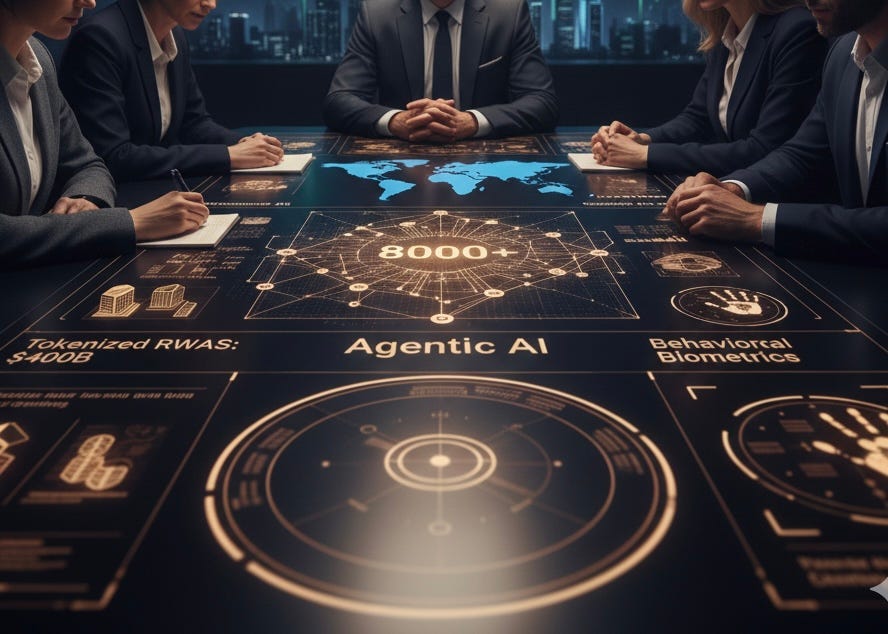
2026 is shaping up to be the year of the “Great Reality Check.” We are moving past the “experimentation phase” and into a period where the winners are defined by their ability to scale autonomous systems while navigating a fragmented, high-stakes geopolitical landscape.
By blending the current market data with your specific insights, we can identify seven core pillars that will define the financial and tech landscape in 2026.
1. The Era of “Agentic Finance” (Operational ROI)
The biggest shift in 2026 is the transition from AI Copilots (suggestions) to AI Agents (execution).
Autonomous Workflows: 15–30% of routine corporate decisions—from procurement to treasury management—will be handled by multi-agent systems.
Measurable “ROAI”: Shareholders will no longer accept “innovation pilots.” In 2026, the success metric is Return on AI Investment (ROAI), specifically through shortened release cycles and 20%+ revenue growth in software-driven sectors.
Agentic Banking: For consumers, this means “self-driving” money. Agents will automatically switch high-yield savings accounts or negotiate better insurance premiums in the background.
Company to Watch: Microsoft (MSFT)
Having integrated agents across Office 365 and GitHub, Microsoft is the primary beneficiary of the “Agentic ROI” era. Their 2026 launch of the world’s most powerful AI data center in Wisconsin will provide the compute necessary to run these autonomous “teammates” at scale.
2. Market Maturation: The “Broadening” of Tech Gains
While the “Magnificent Seven” led the charge in 2024, 2026 will see a broader base of beneficiaries as AI infrastructure becomes a utility.
S&P 500 Targets: With earnings growth doing the heavy lifting, analysts (Wedbush/JPM) eye the 6,000–8,000 range, provided that “Agentic ROI” materializes.
The Hardware Pivot: Beyond Nvidia, we see gains in “Energy-Efficient Tech” (neuromorphic chips and edge AI) as the power grid becomes the primary bottleneck for AI growth.
Company to Watch: Oracle (ORCL)
While Nvidia provides the chips, Oracle has become the dark horse of 2026. Their focus on high-margin, automated database management and specialized AI cloud clusters for the enterprise makes them a primary beneficiary as businesses demand tangible returns on their AI spend.
3. Geopolitics: “Sovereign AI” & The Great Decoupling
Geopolitical tension isn’t just a risk; it’s now a business architecture.
Geopatriation of Data: Over 75% of enterprises will adopt “Sovereign Clouds” (e.g., the Deutsche Telekom/Nvidia “Deutschland-Stack”) to keep data and AI models within national borders.
Supply Chain “Friendshoring”: Stricter export controls on quantum tech and rare earths will force a split in the tech ecosystem—one Western-led, one China-led—increasing costs but creating a boom for domestic semiconductor players (US CHIPS Act 2.0).
Company to Watch: Nvidia (NVDA)
Beyond being a chipmaker, Nvidia is now an “AI Nation-Builder.” Through partnerships like their $1B deal with Nokia and local “AI Factories” in Africa and Asia, they are the hardware backbone for every country building its own national AI infrastructure.
4. The Crypto & Tokenization Supercycle
The “wild west” is dead; 2026 is the year of Regulated Programmable Money.
Institutional Rails: Stablecoins are expected to surpass a $500B market cap, becoming a standard interbank layer.
Tokenized RWAs: Real-World Assets (Treasuries, Private Equity) will grow 10x to roughly $400B, as instant (”atomic”) settlement becomes the requirement for institutional liquidity.
Regulatory Peace: US and EU frameworks (like the EU AI Act and US market structure laws) finally provide the “rules of the road,” allowing banks to move from pilots to full-scale digital asset custody.
Company/Project to Watch: Ondo Finance (ONDO) or BlackRock (BLK)
As a leader in tokenized U.S. Treasuries, Ondo represents the bridge between DeFi and trad-fi. Meanwhile, BlackRock’s continued expansion of its “BUIDL” tokenized fund makes it the institutional kingmaker of the RWA space in 2026.
5. Trust as a Competitive Moat (Security)
As AI scales, so does the sophistication of attacks.
Deepfake Defense: With deepfake-related fraud losses projected to hit $40B in the U.S., banks will differentiate themselves based on “Security ROI.”
Behavioral Biometrics: The password is officially legacy. 2026 will see the rise of Continuous Verification, where your identity is verified by how you type, hold your phone, and move, rather than what you remember.
Company to Watch: CrowdStrike (CRWD)
By 2026, CrowdStrike will have fully pivoted to “identity-first” security. Their Falcon platform is positioned to be the primary defense against AI-driven social engineering, making them an essential utility for the 2026 financial ecosystem.
6. Quantum: From Theoretical to “Inevitability”
Quantum computing will hit the “Utility-Scale Pilot” phase in 2026.
Commercial Milestones: Systems with 1,000+ qubits (Quantinuum, Pasqal) will be accessible via the cloud for high-value optimization tasks in drug discovery and financial risk modeling.
Post-Quantum Cryptography (PQC): Financial institutions will begin a massive migration to quantum-safe encryption to protect long-term data from “harvest now, decrypt later” threats.
Company to Watch: Alphabet (GOOGL)
Google’s Quantum AI team is on track to hit its “Milestone 3” roadmap in 2026: demonstrating the first stable, fault-tolerant logical qubit using the Willow chip. Unlike pure-play quantum startups that may face a “capital crunch” in 2026, Alphabet’s massive cash flow from its AI-integrated Search and Cloud business allows it to fund these deep-tech breakthroughs indefinitely, making it the safest “blue chip” way to play the quantum revolution.
Stock to Watch: Honeywell (HON)
Through its majority stake in Quantinuum, Honeywell owns a piece of what many consider the most accurate quantum computer in the world (”Helios”). For investors, Honeywell provides a safer, diversified way to play the quantum “breakthrough” expected in 2026.
7. The Physical AI & Sustainability Collision
The “Metaverse” has evolved into “Physical AI”—the integration of robotics and spatial computing in the workplace.
Spatial Computing and Physical AI Revive AR/VR Momentum: Cheaper, lighter devices and AI integration drive AR/VR resurgence. “VR+” for events/training boosts adoption. Physical AI (embodied robotics) enters enterprises/factories. New revenue in immersive marketing/training; metaverse evolves into practical “phygital” experiences.
The Energy Bottleneck: AI’s hunger for power (demanding 30+ gigawatts of additional capacity) will force a political and financial reckoning, favoring companies that can innovate in “Green Data Centers.”
Company to Watch: Tesla (TSLA)
2026 is the “make or break” year for Tesla’s robotics division. With production scaling toward a projected one million units, the market will value Tesla less as a car company and more as a leader in “Embodied AI” and autonomous labor.
Things will continue to get weirder. The pressure will continue to grow. Your job is to figure out how to flow with the currents instead of being knocked down by the waves.