


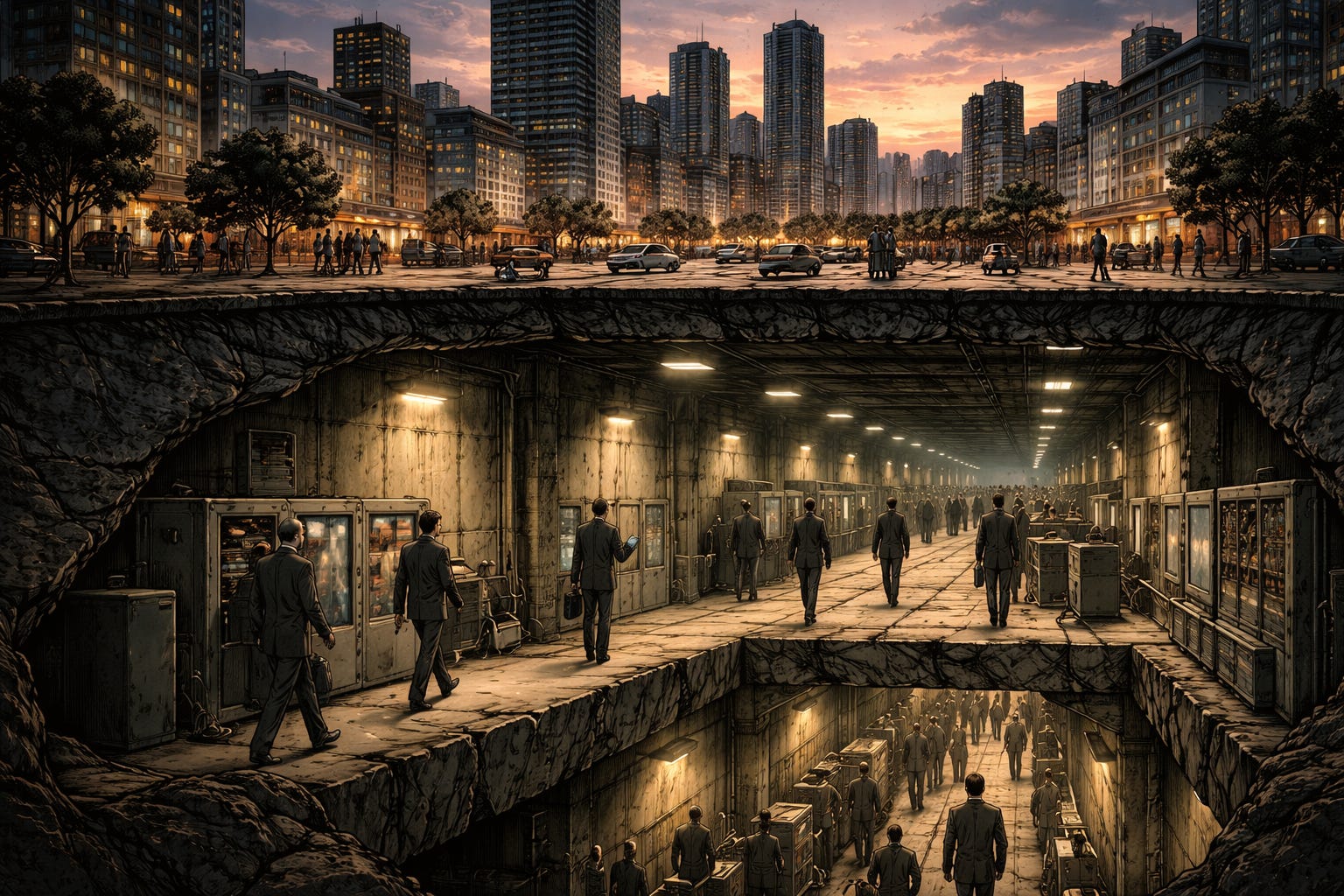
There is no emergency broadcast. No official acknowledgment that something is wrong. The institutions that are supposed to tell us when to worry are still telling us not to worry.
And yet.
The people with the most information, the most resources, and the most to lose have spent the last two decades quietly building exits. Not panicking. Preparing. The distinction matters. Panic is reactive. Preparation is a thesis.
This is about the thesis.
The Signal in the Behavior
Markets have a concept for this. When corporate insiders sell shares ahead of bad earnings, you don’t need the memo. The trade is the signal. The behavior reveals the belief.
Apply that logic to the broader behavior of sovereign funds, ultrawealthy individuals, national governments, and legacy institutions over the last twenty years and something comes into focus. Not a coordinated conspiracy, but something more interesting than that. Convergent hedging. Independent actors with asymmetric information access all making correlated moves in the same direction.
When enough of them do that, the correlation itself becomes data.
Financial Infrastructure
The first layer of preparation is monetary.
Nations that spent decades operating inside the dollar system have been quietly building around it. BRICS settlement infrastructure, bilateral currency agreements, and alternative payment rails are not just geopolitical posturing — they are hedges against a world where dollar weaponization becomes unpredictable. The message underneath the diplomacy: we need the ability to operate if the current system becomes a liability.
Gold repatriation tells a similar story. Germany, Poland, Hungary, and others pulled their reserves home over the last decade. Storing gold in your own vault instead of someone else’s is only necessary if you’ve started thinking about scenarios where someone else’s vault becomes inaccessible. That thought didn’t used to be thinkable at the sovereign level. Now it’s policy.
CBDCs read differently in this context too. The official framing is modernization and financial inclusion. But programmable money is also a crisis management tool — the ability to direct, restrict, and surveil capital flows at the infrastructure level is exactly what a government needs when civil order is under stress.
And then there’s the private crypto play. The Trump family’s aggressive positioning across World Liberty Financial, stablecoin adjacency, and crypto deregulation isn’t just opportunism. It’s a bid to become foundational infrastructure for the next monetary regime — to be the rails the next system runs through. Dynasty cemented not through politics but through protocol capture. The fourth turning as a business model.
Physical and Geographic
The second layer is physical.
The bunker industry is not a conspiracy theory. It is a disclosed, growing, institutionally covered market. Vivos, xPoint, and a network of private survival infrastructure providers have been expanding for years. Their clientele is not paranoid preppers — it is ultrawealthy individuals and families who have decided that continuity planning belongs in the same category as estate planning.
New Zealand became a destination of choice for a specific kind of wealthy expatriate in the 2010s. Remote, stable, defensible, with immigration pathways designed to attract high net worth individuals. The pattern was documented enough that New Zealand eventually moved to restrict it.
Seed vaults extend the logic to civilizational continuity. Svalbard is the most visible but dozens of national-level programs exist. Somebody decided that preserving genetic diversity of the global food supply was important enough to build refrigerated vaults inside an Arctic mountain. That decision implies a specific kind of foresight about what could be lost.
China’s strategic stockpiling operates at scale. Grain reserves, rare earth accumulation, energy infrastructure — a sustained program of acquiring the physical inputs that matter most if global supply chains fracture. You stockpile when you believe the store might close.
Water rights acquisition is quieter but follows the same logic. Sovereign funds and wealthy individuals have been accumulating aquifer rights across the American West and other water-stressed regions for years. Water is the asset that only matters if things go wrong — which is exactly why it’s being bought now.
Knowledge and Continuity
The third layer is informational.
The Internet Archive exists because someone decided that digital knowledge needed redundant preservation. Private libraries, data continuity projects, and genome banks operate on the same premise — that the information infrastructure of the current civilization is worth protecting against a scenario where it doesn’t survive intact.
AI training data hoarding is the newest version of this. The corpus that models are trained on is the seed vault for machine intelligence. Whoever controls the data that reconstructs AI capability after a disruption controls a foundational asset of the next era. That positioning is already underway.
Geopolitical and Institutional
The fourth layer is structural.
NATO expansion reads as perimeter hardening before a contested period — building the alliance architecture while the window is still open. Gulf states are diversifying away from oil dependency now, before they have to, which implies a belief about when the window closes. International institutions — the WHO, WTO, the post-war multilateral order broadly — are losing credibility and capability in ways that look less like neglect and more like managed withdrawal by the states that built them.
One underdiscussed driver of geopolitical instability is the role of religious eschatology in active policy. Christian Zionist influence on US foreign policy is documented and substantial — a constituency that reads current Middle East events through an endtimes framework and has meaningful access to decision-makers. The third temple movement in Israel, accelerationist theology, and the political theology of figures with real institutional power represent something specific: actors who are not merely predicting a civilizational crisis but actively trying to precipitate one. That is a different category of risk than miscalculation or institutional decay. It is intentional pressure on an already stressed system.
The elite migration pattern completes the picture. Portugal, UAE, Paraguay, New Zealand — the geography of where high net worth individuals have been establishing secondary residency and citizenship over the last decade is not random. It is a map of places that score well on a specific set of criteria: political stability, physical security, distance from likely conflict zones, and favorable treatment of mobile capital.
Corporate Infrastructure
The fifth layer of preparation is institutional.
Companies don’t build bunkers. They build redundancy. And the pattern of corporate investment over the last several years reveals the same underlying logic as everything else on this list — a quiet, systematic hedge against a world where the current order becomes unreliable.
The clearest signal is energy. Microsoft, Google, and Amazon have all signed small modular reactor agreements in the last two years. Nuclear power is expensive and slow — companies don’t pursue it for cost efficiency. They pursue it because they have decided they cannot depend on the grid. When the largest technology companies in the world start building their own power infrastructure, that is not an environmental statement. It is a continuity plan.
Supply chains tell the same story. The lean “just in time” model that defined global manufacturing for thirty years is being systematically dismantled and replaced with “just in case” — redundant suppliers, nearshored production, domestic capacity that costs more but doesn’t fail when a distant factory shuts down. Apple, Intel, and TSMC are all building domestic fabrication capacity at enormous expense. The economics don’t fully justify it. The risk calculus does.
The geographic pattern mirrors the individual one. Singapore, Dubai, and Switzerland have seen sustained corporate relocation and operational headquarters splits — jurisdictions chosen for political stability, rule of law, and distance from likely disruption zones. Companies are quietly distributing their critical functions across multiple geographies for the same reason wealthy individuals are acquiring second passports.
The word corporations use for all of this is “resilience.” The function is identical to the bunker.
What It Means
None of this requires a specific catastrophe. That’s the point.
The bunker and the protocol capture and the gold repatriation and the seed vault are not responses to a known event. They are responses to a known type of event — a period of systemic instability where the current order fails to hold and whatever comes next gets shaped by whoever survived with infrastructure intact.
The historians Strauss and Howe called this the Fourth Turning — a crisis period that recurs roughly every eighty years, during which institutional orders collapse and are replaced. The last one produced the New Deal, World War II, and the postwar architecture that still nominally governs the world. The argument that we are in the next one is not fringe. It is made seriously by serious people.
What the convergent behavior of elites suggests is that the people with the most to lose believe something like this is coming. They are not announcing it. They are not coordinating it. They are each, independently, making the same bet.
The bet is not that the world ends. The bet is that the current order ends — and that the transition is the dangerous part.
The exits are already built. The question is whether you noticed before or after you needed one.