


Today (October 9), all major precious metals are seeing strong gains. This is further confirmation of the thesis of systemic debasement and capital’s move toward scarcity.
What’s happening now
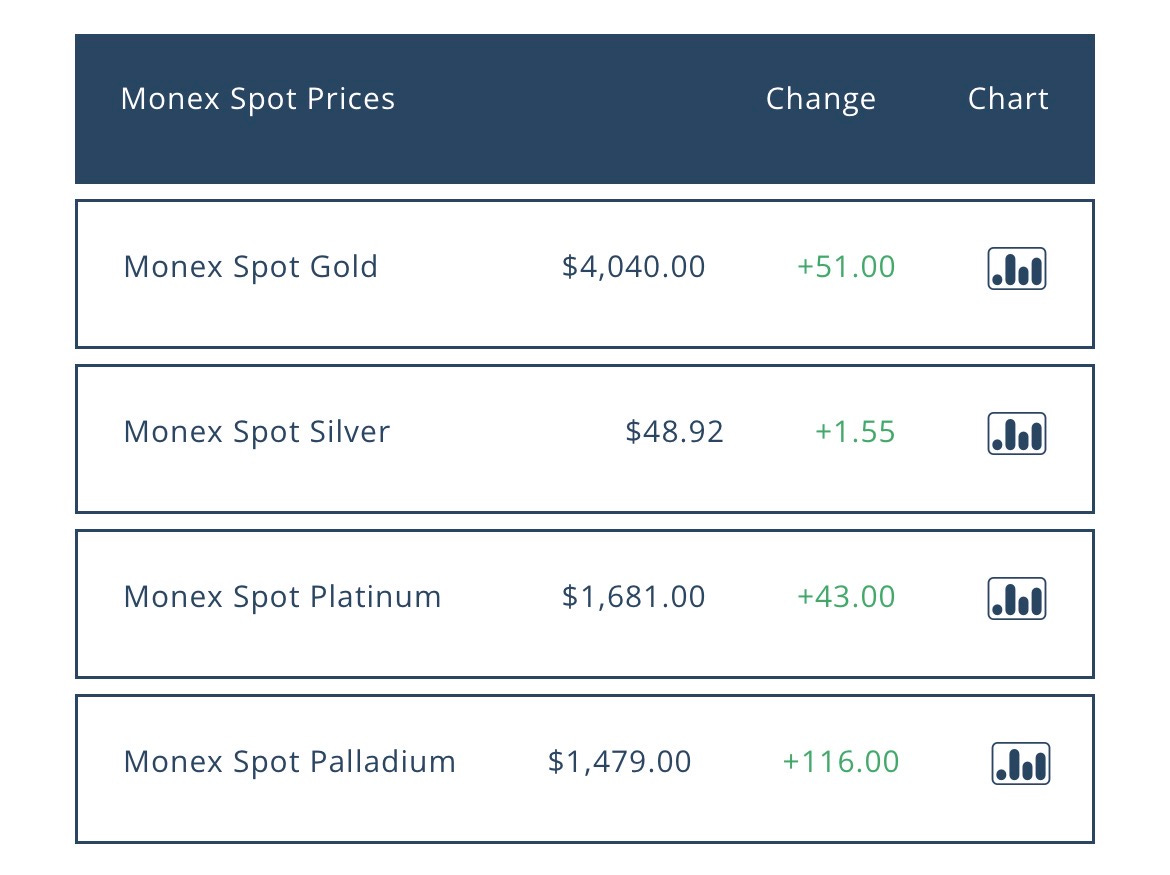
Gold has pushed past $4,000/oz, reaching fresh record highs amid inflation fears, global uncertainty, and weakening confidence in the U.S. dollar. (Financial Times)
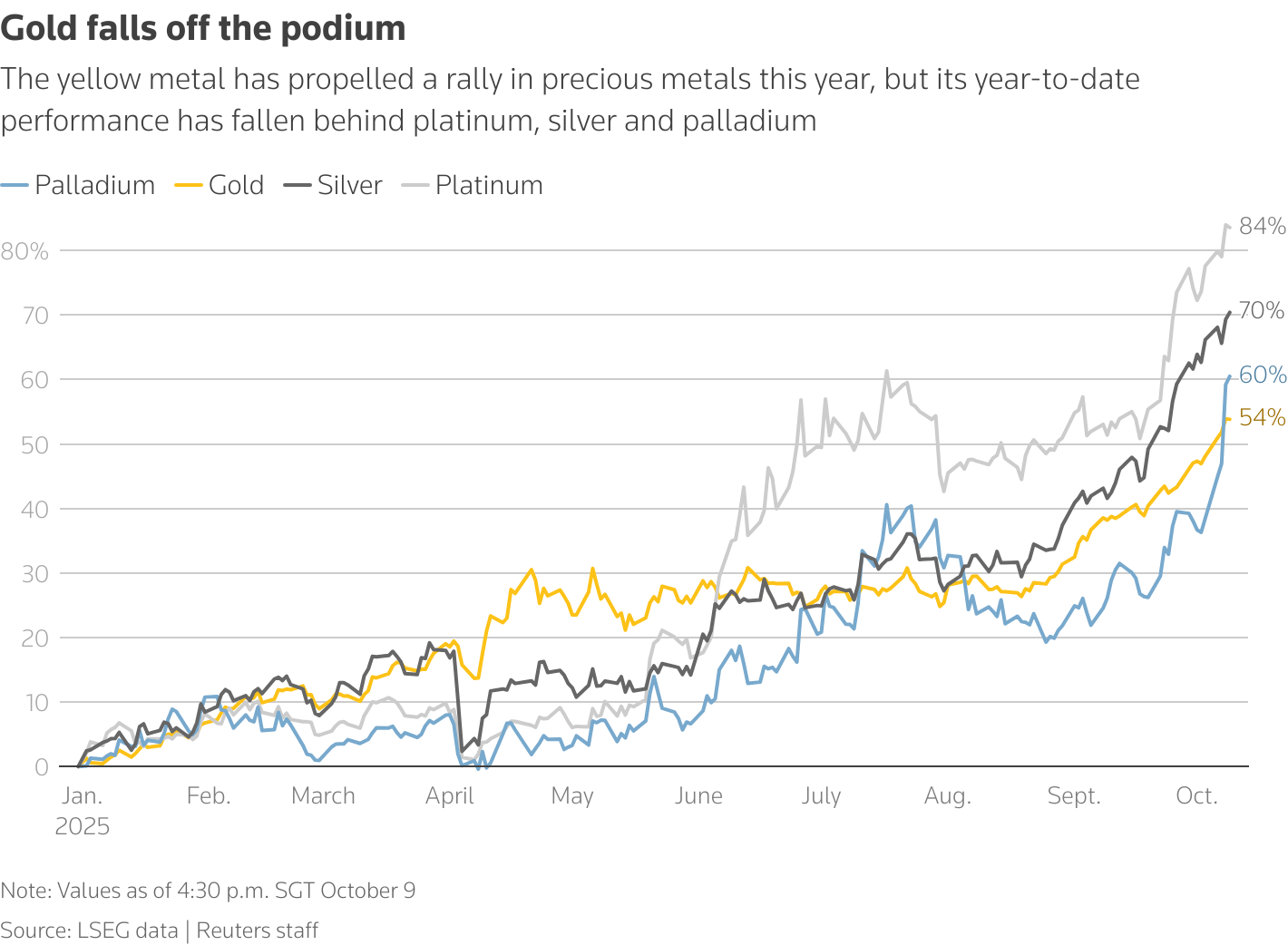
Silver is hitting all-time highs, climbing toward $49.57/oz, up ~70 % year-to-date. (markets.businessinsider.com)
Platinum is outperforming gold this year, up ~83 %. (Reuters)
Palladium is also seeing strong gains, ~60 % year to date. (Reuters)
Current spot prices (approximate): Gold $4,037/oz; Silver $49.58/oz; Platinum $1,667/oz; Palladium $1,456/oz. (Kitco)
What this signals in context
These rallies are not random. They show real capital fleeing fiat risk toward assets that cannot be printed.
The strength across all precious metals—not just gold—underscores the broad distrust in currency as the anchor store of value.
The surge confirms that measurement by inflation metrics alone is insufficient. The dollar is falling in comparisonto these finite assets.
Markets are validating the structural thesis: the denominator (the dollar) is eroding, and the numerator (hard assets) is absorbing the shift.
Central banks and large institutions are doubling down on this trend—many are increasing gold reserves even as they exit U.S. Treasuries. (Reuters)
Key takeaways (a reminder)
The dollar’s decline is better measured against gold, Bitcoin, commodities, and labor, not just CPI.
Gold is up over 70 % since 2019, largely due to declining faith in fiat.
The dollar’s global reserve share continues to slip.
Accepting negative real yields in paper assets is part of the trade now—tangible assets outperform.
We are deep in the phase where asset prices rise not because of real growth, but because the unit of account is eroding. Today’s gains in metals affirm that reality.
Would you rather hold the crumbling measure—or what holds when everything else decays?