


There is a common mistake people make when analyzing Elon Musk.
They treat each of his companies as separate bets.
Tesla is a car company. SpaceX is a rocket company. X is a social network. xAI is an AI startup. Neuralink is a brain-chip moonshot. The Boring Company digs tunnels.
That framing is convenient for analysts. It is clean. It fits neatly into sector buckets.
It is also incomplete.
If you zoom out far enough, a pattern emerges. Not a brand portfolio — a systems architecture.
What Musk appears to be building is not a collection of companies. It is a vertically integrated infrastructure stack for a specific vision of the future.
Energy. Compute. Mobility. Communications. Orbit. Human interface.
Call it the Musk Stack.
The question is not whether they formally merge. The question is whether they already function like layers of the same system.
Layer One: Energy — The Base Constraint
Every civilization runs on energy.
Industrial growth, AI training, transportation, manufacturing — all of it reduces to electricity and power density.
Tesla is often misunderstood as an automaker. But its deeper role is energy infrastructure: solar generation, grid-scale battery storage, distributed residential energy systems, and electric powertrains.
If AI becomes the core productivity engine of the global economy, then energy becomes the bottleneck. Data centers strain grids. Cooling becomes political. Transmission becomes contested.
Tesla’s Megapack 3 and Megablock systems are not accessories to vehicles. They are large-scale grid storage solutions designed to support the coming power constraint.
In the Musk Stack, energy is the foundation. Without abundant, controllable energy, everything above it collapses.
Layer Two: Compute — Intelligence as Infrastructure
Artificial intelligence is not an app. It is a coordination layer.
This is where the stack gets messy — and revealing.
In February 2026, SpaceX acquired xAI in a deal valuing the combined entity at $1.25 trillion. xAI, which had been burning approximately $1 billion per month, now sits under the SpaceX umbrella alongside the X social platform.
The stated rationale: orbital data centers. SpaceX has filed with the FCC for authorization to launch up to 1 million satellites as part of an “orbital data center” vision.
Whether that becomes real or not, the structural logic is clear. AI training requires massive compute, which requires massive energy. Terrestrial grids struggle to supply it at scale. Orbit offers near-constant solar exposure, no zoning boards, and heat radiation directly into space.
Meanwhile, Tesla shut down its custom Dojo supercomputer project in August 2025, calling it “an evolutionary dead end.” But in January 2026, Musk restarted Dojo 3 — this time focused on space-based AI compute using Tesla’s in-house AI5 and AI6 chips.
Tesla’s current Cortex system uses 67,000 Nvidia H100-equivalent GPUs. But the long-term plan appears to be full vertical integration: Tesla-designed chips, space-based deployment, Starlink connectivity.
If AI models become increasingly embedded in transportation, robotics, logistics, communications, and governance, then compute becomes sovereign infrastructure. In this frame, AI is not separate from Tesla. It is Tesla’s nervous system. It is not separate from X. It is X’s content moderation and personalization engine. It is not separate from robotics. It is robotics.
The Musk Stack treats intelligence as a horizontal layer spanning all verticals.
Layer Three: Mobility — Autonomous Physical Movement
Transportation is energy plus intelligence applied to motion.
Tesla’s autonomous ambitions are not about driver convenience. They are about fleet-level coordination, reduced labor dependency, networked mobility systems, and physical AI embedded in the real world.
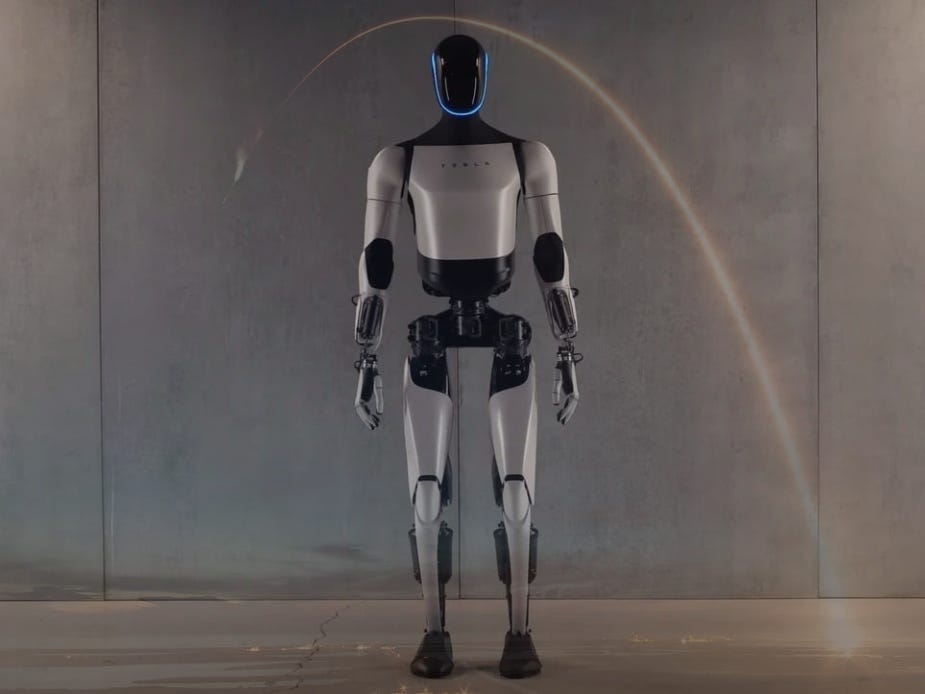
Tesla is expected to begin Cybercab (robotaxi) production in April 2026, alongside mass production of the Tesla Semi and Optimus Gen 3 humanoid robots. The company plans to launch Full Self-Driving in unsupervised mode in 2026.
The Boring Company appears trivial until viewed through this lens. Tunnels are not just tunnels — they are controlled environments optimized for autonomous fleets.
If vehicles become AI-controlled agents, then transportation becomes a software network riding on physical rails. Mobility becomes programmable.
Layer Four: Communications — Global Low-Latency Connectivity
Modern civilization depends on information moving faster than matter.
SpaceX builds rockets. But rockets are the delivery mechanism for something else.
Starlink is the strategic asset: a global low-latency communications layer independent of terrestrial infrastructure. As of 2026, Starlink has over 9,000 satellites in orbit serving more than 9 million customers globally.
This matters for military resilience, emerging market connectivity, remote industrial operations, autonomous fleets, and global AI deployment.
A dense satellite network reduces dependency on undersea cables and regional infrastructure. Communications sovereignty becomes orbital.
In a future where AI systems coordinate vehicles, robots, and data centers globally, low-latency connectivity is not optional. It is structural.
Layer Five: Orbit — Expanding the Economic Surface Area
Space is not a side quest. It is optionality.
If launch cadence increases dramatically, orbit becomes industrial territory.
SpaceX launched 165 Falcon 9 rockets in 2025 — more than the rest of the world combined. One booster flew 32 times. Turnaround time: as short as three weeks.
This is where the Musk Stack diverges from traditional tech conglomerates. SpaceX is bending the launch cost curve. Reusability and frequency shift the economics of accessing orbit.
Why does this matter?
Because once orbit becomes economically accessible, solar energy capture scales, manufacturing constraints shift, communications redundancy increases, resource extraction experiments become feasible, and defense strategy evolves.
The long-term vision often centers on Mars. That is narrative gravity. The more immediate implication is orbital infrastructure at scale.
The moment orbit becomes routine, the economic boundary of Earth expands.
Layer Six: Human Interface — Direct Integration
Neuralink is the most speculative layer. It is also the clearest expression of the long-term thesis.
If AI becomes superhuman in capability, humans must either compete, regulate, or integrate. Neuralink represents the integration path.
As of early 2026, Neuralink has approximately 20 participants in clinical trials across the U.S., Canada, UK, UAE, and Germany. The company received FDA Breakthrough Device Designation for both its Blindsight vision restoration system and its speech restoration technology in 2025.
In January 2026, Musk announced that Neuralink would move to high-volume production and “almost entirely automated” surgical procedures in 2026. The new procedure allows implant threads to go through the dura without removing it — a significant technical advancement.
Direct brain-computer interfaces could restore neurological function, enhance human cognition, and interface directly with AI systems.
Whether this scales is uncertain. But within the Musk Stack, it serves as the final interface between biological and artificial intelligence.
Energy → Compute → Mobility → Communications → Orbit → Human Interface.
That is the architecture.
Is This Coordination or Coincidence?
Skeptics argue these are simply independent companies driven by a charismatic founder. That is partially true. They are legally separate. They have distinct investors and governance structures.
But functional integration does not require legal consolidation.
Cross-layer integration can occur through shared talent networks, shared technological primitives, aligned capital incentives, narrative coherence, and API-level interoperability.
If Tesla vehicles use Starlink connectivity. If xAI models integrate into X distribution. If autonomous fleets rely on orbital redundancy. If energy storage feeds AI training centers. If Neuralink interfaces with Tesla’s AI systems.
The stack operates as one system — regardless of corporate paperwork.
Financial Implications
Markets currently price these companies within conventional sector frameworks: Tesla as automotive/EV, SpaceX as aerospace, X as media, xAI as speculative AI startup.
If investors begin viewing them as a coordinated infrastructure stack, pricing models shift.
The xAI acquisition already demonstrates this. SpaceX is not just buying an AI company. It is integrating compute capability into its orbital infrastructure thesis. The valuation reflects that systemic view.
Conglomerate discounts may apply — or infrastructure premiums. Systemic risk concentration becomes a factor. If multiple layers of critical infrastructure align under a single strategic vision, regulatory scrutiny intensifies.
Capital access improves in bull cycles and compresses in stress cycles. Integration increases upside leverage — and downside correlation.
In finance terms: systemic beta rises.
The Geopolitical Dimension
This stack does not exist in a vacuum.
Communications networks are strategic. Launch capacity is strategic. AI is strategic. Energy infrastructure is strategic.
When one founder influences multiple strategic layers, the system becomes politically sensitive.
Governments may subsidize, regulate, compete, or restrict. Space, AI, and energy are no longer purely commercial sectors. They are geopolitical levers.
The Musk Stack operates at that boundary.
The Unified Vision
Strip away brands and personalities.
The coherent vision appears to be: a vertically integrated, AI-coordinated, energy-abundant civilization spanning Earth and orbit.
It is not about cars. It is not about rockets. It is not about social media.
It is about reducing bottlenecks across the entire technological stack.
Energy bottleneck → addressed by Tesla. Compute bottleneck → addressed by xAI, Cortex, and Dojo 3. Mobility bottleneck → addressed by autonomy and Optimus. Connectivity bottleneck → addressed by Starlink. Launch bottleneck → addressed by SpaceX. Biological bottleneck → addressed by Neuralink.
Each company removes friction from a different constraint. Together, they form a civilization thesis.
Risks
Integration brings efficiency. It also brings fragility.
A regulatory crackdown on one layer could spill into others. A geopolitical conflict affecting Starlink impacts defense and communications simultaneously. AI failures cascade into mobility networks. Launch accidents affect orbital infrastructure confidence.
Concentrated control amplifies systemic impact. The Musk Stack increases upside convexity — and downside correlation.
The Dojo shutdown and restart illustrates this. When Tesla pivoted from custom chips to Samsung-manufactured AI6 chips, it affected not just Tesla’s autonomy roadmap but the entire compute layer of the stack. That decision rippled through SpaceX’s orbital AI plans and xAI’s infrastructure strategy.
Why This Matters Now
The reason this topic is timely is not personality. It is convergence.
AI demands energy. Energy demands infrastructure. Infrastructure demands coordination. Coordination demands connectivity. Connectivity benefits from orbit.
Each of Musk’s companies sits at one of these pressure points.
Whether intentional or emergent, the architecture is visible.
The xAI merger made it explicit. The Dojo 3 restart for space-based compute confirmed it. The Neuralink production scale-up connects it. The Starlink expansion enables it.
Investors can dismiss it as coincidence. Or they can recognize that the companies collectively map onto the core constraints of 21st century civilization.
Final Thought
History rarely rewards those who analyze companies in isolation when structural shifts are occurring.
Railroads were not just transportation stocks. Oil companies were not just fuel vendors. Telecom firms were not just utilities. They were infrastructure layers that redefined economic boundaries.
The Musk Stack, if it continues integrating functionally, represents a similar ambition: not to dominate a sector, but to build the stack upon which sectors operate.
The open question is not whether it is ambitious. It is whether the cost curves bend fast enough — in energy, AI, launch, and autonomy — to make the stack economically inevitable.
If they do, markets will eventually price these companies not as isolated entities but as layers of a single operating system for the future.
And when that repricing happens, it will not be gradual.