


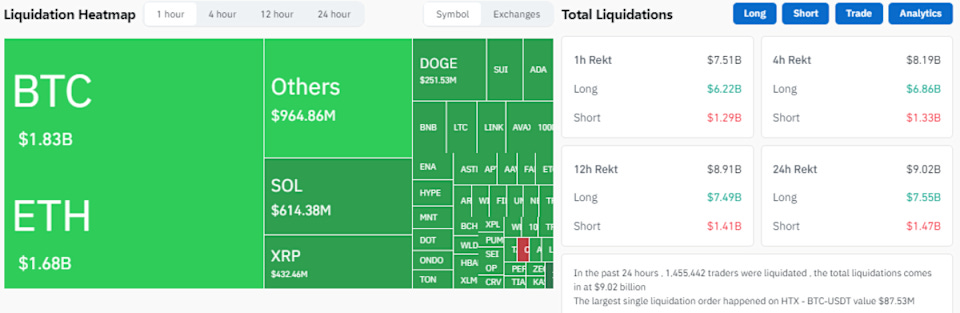
The cryptocurrency market faced a sharp correction on October 10, 2025, marking the largest single-day liquidation event in crypto history. Over $19 billion in leveraged positions were wiped out across 1.6 million traders, making it more than 12 times larger (in dollar terms) than the FTX collapse or the 2020 COVID crash.
Bitcoin dropped roughly 10%, from around $121,000 to below $110,000, while major altcoins like Ethereum and Solana fell 15–30%.
Total market capitalization declined by about 15%, or $660 billion, settling near $3.64 trillion.
What Triggered It
Macro catalyst: In response to China’s limiting of rare earth exports, President Trump announced 100% tariff on Chinese imports sparking a global risk-off reaction.
Dollar strength: The U.S. Dollar Index climbed 0.5%, pulling liquidity out of risk assets.
Excess leverage: Traders on platforms like Bybit and Hyperliquid were betting 50x–250x leverage, where a 2–4% move could wipe out positions entirely.
The result: 96% of long positions were liquidated in the first hour, over $7 billion erased in minutes.
This chain reaction turned what should have been a routine 5–10% dip into a cascading sell-off.
What Actually Happened
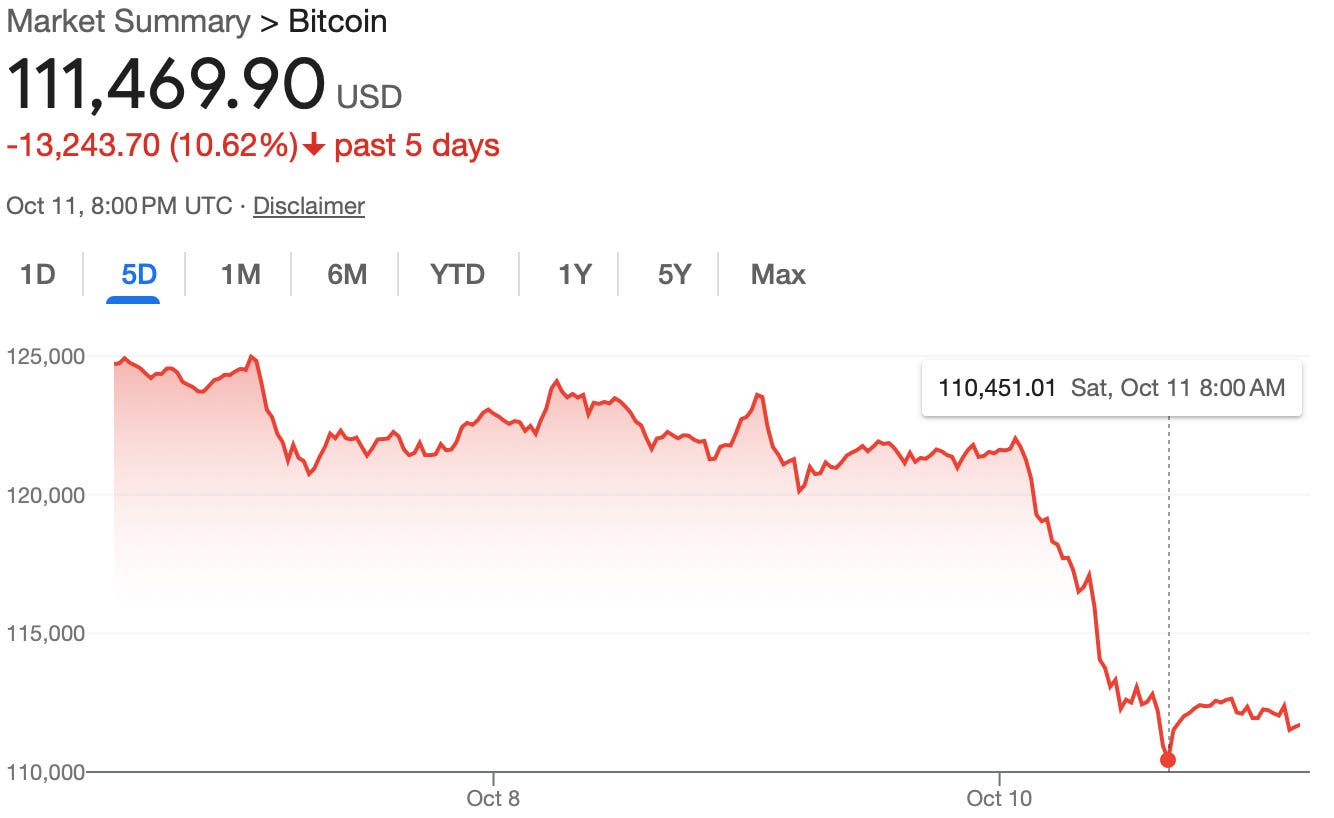
For long-term Bitcoin holders, the panic was more noise than signal. Bitcoin prices simply returned to mid-September levels around $105,000–$110,000.
Spot markets showed minimal stress, posting a net 2–3% decline after a swift rebound to $113,000.
Bitcoin dominance rose to 63%, confirming its position as a safe-haven asset during volatility.
Altcoins, driven by speculation, absorbed most of the damage.
Why It Matters
This event highlights a clear divide between speculative leverage and fundamental value.
The collapse was caused by traders overextending risk, not by weakness in Bitcoin’s foundation.
Bitcoin’s resilience reaffirmed its role as a decentralized, non-sovereign hedge against fiat instability.
The correction purged excess leverage from the system, restoring market health and structural balance.
Broader Context
Historical precedent supports this pattern. Post-halving corrections in 2018 and 2020 followed the same script: leverage unwinds before new accumulation phases.
With an 85% chance of a Fed rate cut later this month, liquidity could soon return to markets.
The China tariff represents typical macro risk. No different from trade shocks that temporarily shake equities or commodities.
The Bigger Picture
Bitcoin remains a long-term hedge against dollar debasement, mounting deficits, and structural inflation.
Altcoins remain vulnerable to speculative excess, reinforcing Bitcoin’s safe-haven narrative.
For disciplined investors, this is a cyclical reset, not a collapse.
In short:
The largest liquidation in crypto history wasn’t the end of the cycle. Bitcoin’s fundamentals remain untouched. Speculators were punished, conviction holders were rewarded, and the market’s excess has been burned off.