


The short version
A crypto ETF (Exchange-Traded Fund) lets you invest in cryptocurrency through your regular brokerage account, just like buying a stock or S&P 500 ETF.
Instead of holding Bitcoin or Ethereum directly, you buy shares of a fund that tracks their price.
That means:
No wallets or private keys to manage.
No crypto exchanges to sign up for.
Exposure to crypto’s upside — inside the stock market system you already know.
In other words, crypto ETFs are crypto exposure for traditional investors.
What an ETF is (and why it matters)
Before we get specific, a quick refresher:
An ETF is a basket of assets (stocks, bonds, commodities, etc.) that trades on an exchange.
You buy shares in the ETF, not the underlying assets directly.
Crypto ETFs follow the same structure — but instead of tracking the S&P 500 or gold, they track Bitcoin, Ethereum, or crypto-related indexes.
Two main types of crypto ETFs
Not all crypto ETFs are the same. They differ mainly by what they actually hold.
1. Spot ETFs (hold the actual crypto)
The fund owns real Bitcoin or Ethereum held in secure custody.
The share price directly reflects the market price of the underlying crypto.
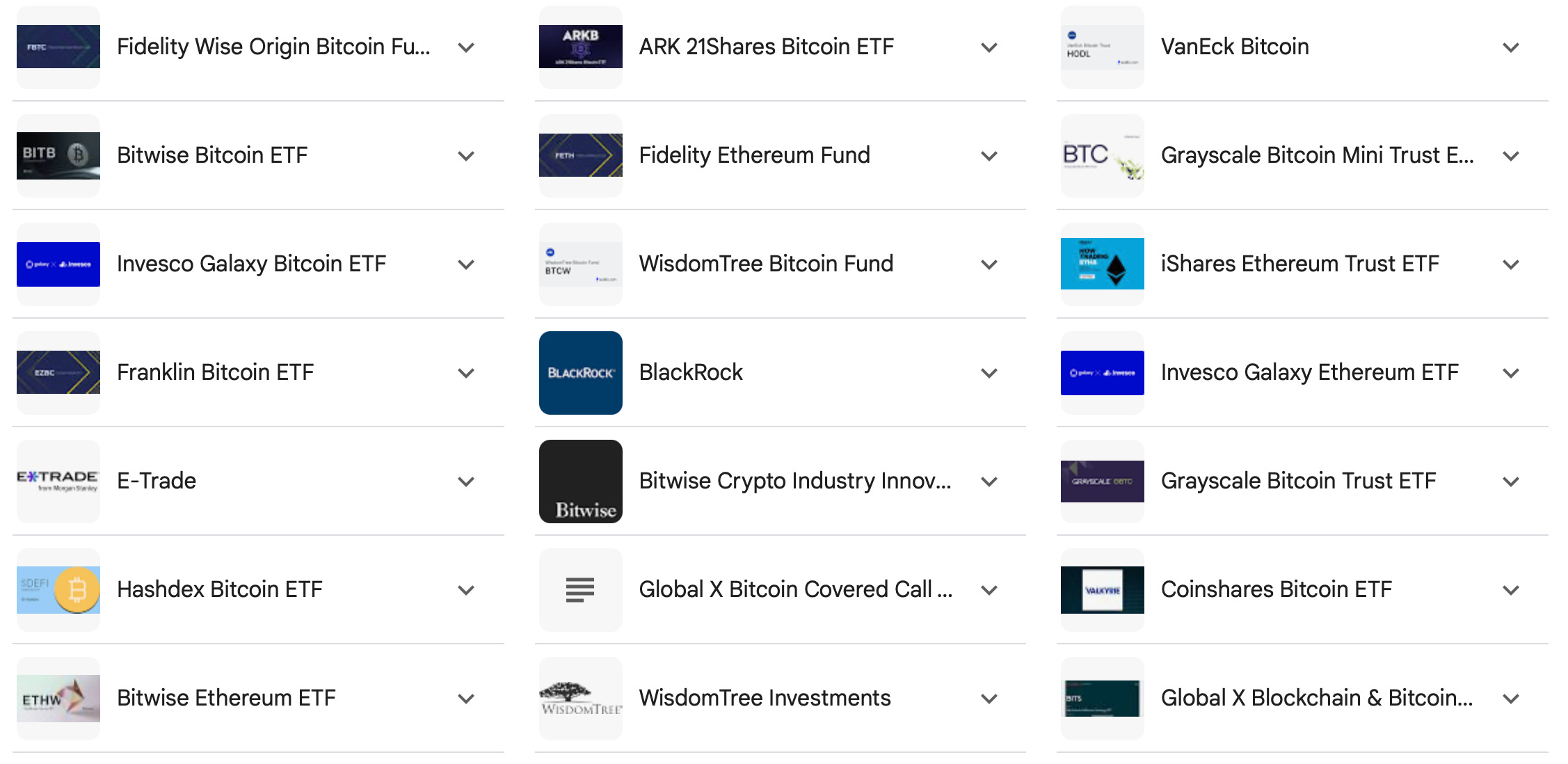
Examples: iShares Bitcoin Trust (IBIT), Fidelity Wise Origin Bitcoin Fund (FBTC), ARK 21Shares Bitcoin ETF (ARKB), and the 2025 crop of spot Ethereum ETFs.
These are considered the cleanest, most accurate crypto trackers.
2. Futures ETFs (hold crypto futures contracts)
The fund doesn’t own crypto — it holds futures contracts traded on regulated exchanges like the CME.
Futures track expected future prices, not the spot market.
Examples: ProShares Bitcoin Strategy ETF (BITO) and Valkyrie Bitcoin Strategy ETF (BTF).
Futures ETFs came first (approved in 2021). Spot ETFs followed in 2024, offering more direct exposure.
How a crypto ETF actually works
When you buy a crypto ETF share:
You send your money to the ETF provider via your brokerage (just like any other ETF).
The fund’s custodian (like Coinbase Custody or Fidelity Digital Assets) buys and stores the underlying Bitcoin or Ethereum.
The ETF’s price moves almost exactly with the crypto’s price (minus small fees).
You can sell your ETF shares anytime during market hours, through your brokerage account.
You never handle the crypto yourself. The ETF manager does all the custody and compliance work behind the scenes.
Why investors use crypto ETFs
Crypto ETFs exist for one main reason: they make crypto investing easy and compliant.
You can:
Get crypto exposure in retirement accounts (IRAs, 401(k)s, etc.).
Avoid setting up crypto wallets or dealing with exchanges.
Stay within your normal investment platform (Schwab, Fidelity, E*TRADE, etc.).
Rely on regulated custody and audits.
Trade, track, and rebalance just like any other stock or ETF.
For many investors, it’s the safest and simplest way to “dip a toe” into crypto.
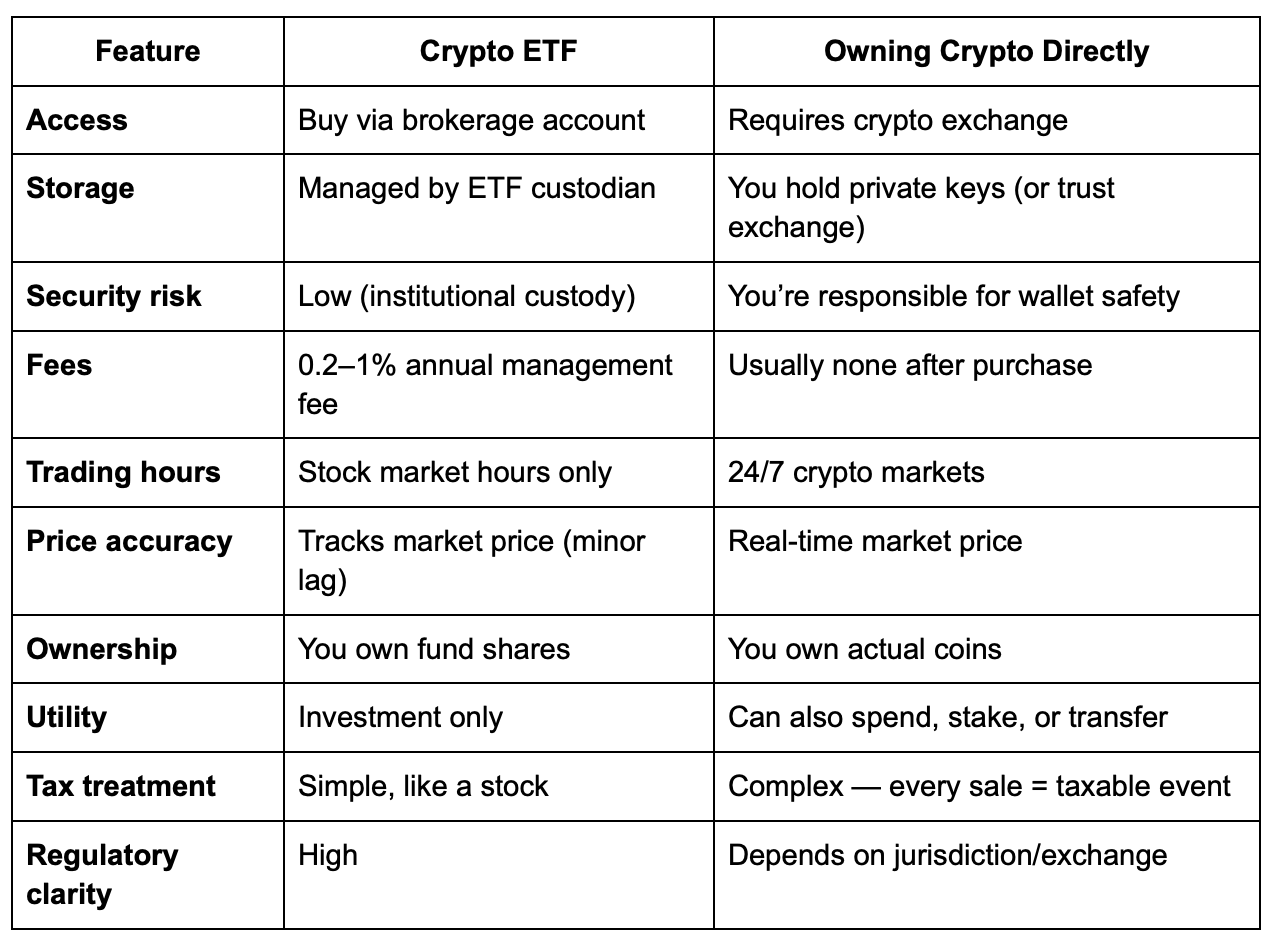
Pros vs. Cons — ETF vs. owning crypto directly
Bottom line:
Use an ETF if you want simplicity, compliance, and portfolio exposure.
Own crypto directly if you want true control and the ability to use it within the ecosystem.
How to choose which crypto ETF to buy
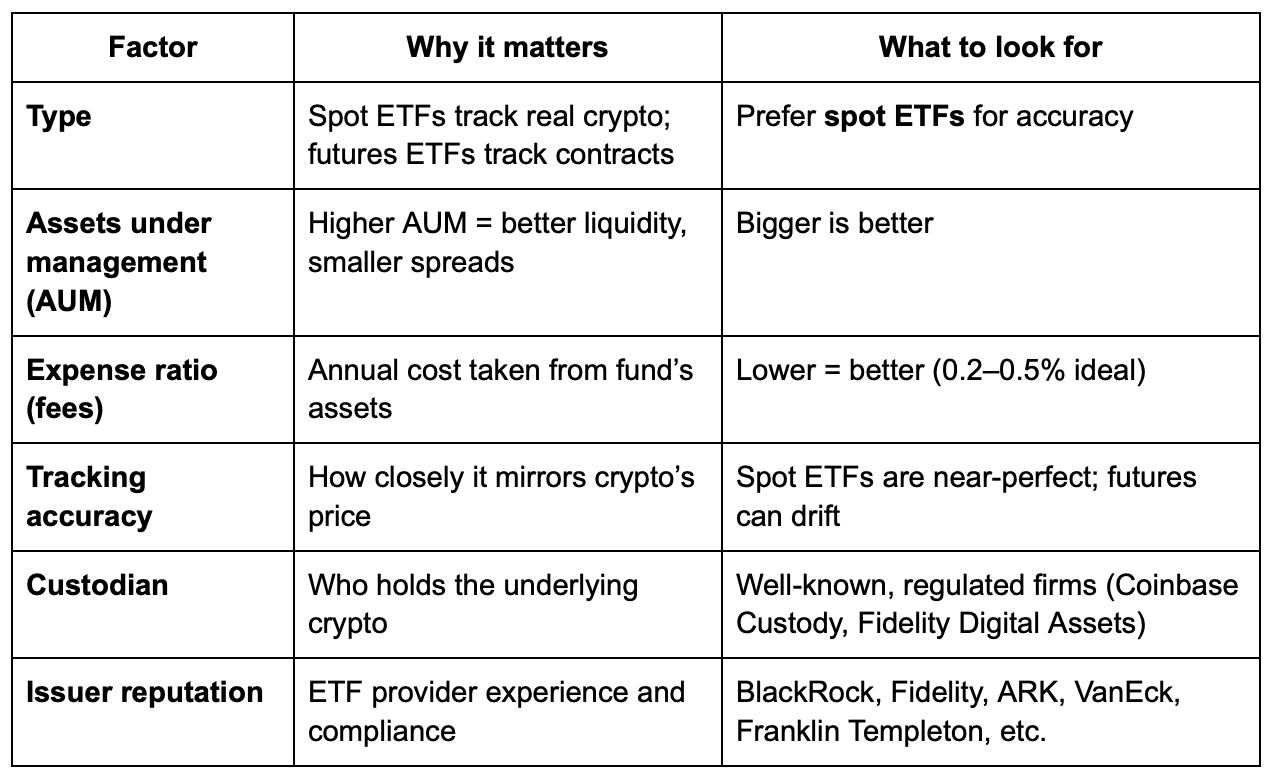
When comparing ETFs, look beyond the name. Focus on:
Spot ETFs vs Futures ETFs — real-world difference
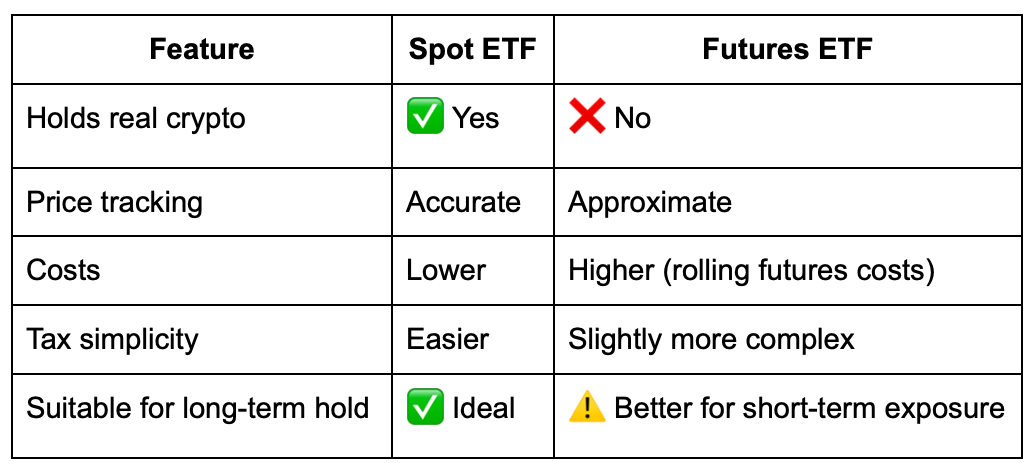
If you’re investing for months or years, go with spot ETFs.
Futures ETFs are better for traders who want short-term exposure without holding crypto.
Taxes and reporting
Crypto ETFs are taxed like stocks — simple capital gains rules apply:
Hold >1 year = long-term capital gains rate.
Sell <1 year = short-term (ordinary income) rate.
No need to file crypto-specific forms or track individual wallet transactions.
This is a huge benefit over direct crypto ownership, which requires meticulous transaction tracking.
Risks and considerations
Even though crypto ETFs make things easier, there are still real risks:
Market risk: Crypto prices are volatile; ETF shares can fall sharply.
Tracking risk: Small differences between ETF and underlying price.
Management fees: Annual drag on returns.
Regulatory changes: Governments could change rules around custody, taxation, or classification.
Limited market hours: Crypto trades 24/7; ETFs don’t — weekend price swings can cause Monday volatility.
When a crypto ETF might make sense
Crypto ETFs fit well for:
Investors who want crypto exposure in traditional portfolios.
Those who don’t want to manage private keys or deal with exchanges.
Financial advisors adding small crypto allocations for diversification.
Retirement accounts (IRAs/401(k)s) that require regulated assets.
They’re not ideal if:
You want to spend, stake, or self-custody crypto.
You care about owning Bitcoin directly (for philosophical or privacy reasons).
You trade outside market hours or want exposure to smaller coins.
How much to allocate
Financial advisors often suggest treating crypto (via ETFs) as a small satellite position in a diversified portfolio:
Conservative: 1–2%
Moderate: 3–5%
Aggressive: 5–10%
Keep it in perspective — crypto ETFs are high-volatility assets. Size your position accordingly.
The future of crypto ETFs
The ETF era is just beginning. Expect:
Spot Ethereum ETFs (2025) and possibly others (Solana, basket funds).
Multi-asset crypto ETFs mixing Bitcoin, ETH, and other large caps.
Yield-bearing ETFs using staking rewards (if regulators approve).
Inclusion in robo-advisors and 401(k) plans.
Over time, ETFs will be the gateway to mainstream crypto adoption — merging digital assets with traditional finance.
Key takeaways
Crypto ETFs = easy, regulated exposure to Bitcoin or Ethereum via your brokerage account.
Spot ETFs are the best way to track real crypto prices accurately.
They remove the need for wallets, exchanges, or self-custody — but you don’t own the actual crypto.
Pros: simplicity, safety, regulation, easy tax reporting.
Cons: management fees, limited trading hours, and no utility (you can’t use or move the crypto).
Ideal for investors who want to participate in the crypto economy without leaving the traditional financial system.
Final Thoughts
Crypto ETFs mark a turning point. The moment crypto finally fits inside the traditional investing world.
They let everyday investors participate in this new asset class without worrying about private keys, digital wallets, or regulatory gray areas. For most people, that’s the difference between watching crypto happen and actually owning a piece of it.
Whether you’re allocating 1% or 10%, the key is to treat crypto ETFs like any other part of your portfolio: diversify, understand what you own, and don’t chase hype.
Bitcoin and Ethereum ETFs are just the start. Over the next few years, you’ll likely see entire crypto index funds, blockchain infrastructure ETFs, and even yield-generating products built on top of this foundation.
So learn how they work, start small, and stay curious. Crypto ETFs aren’t just about buying digital assets. They’re about opening the door to the next generation of financial markets.