



Bitcoin is digital money that runs on a global, decentralized computer network — no banks, no governments, no middlemen.
It was created in 2009 by a mysterious figure (or group) using the name Satoshi Nakamoto, who wanted to build “a peer-to-peer electronic cash system” that worked without trust in third parties.
Bitcoin is the first and most successful cryptocurrency — and everything that came after it (Ethereum, NFTs, DeFi) started from its core idea:
“Digital money that no one controls, but everyone can verify.”
Why Bitcoin exists
Before Bitcoin, digital payments always relied on intermediaries (PayPal, Visa, or banks) to keep ledgers and prevent fraud. That meant:
Transactions could be reversed or censored.
Users needed permission to access the system.
Fees and delays were baked in.
Bitcoin’s invention solved this long-standing problem in computer science:
How to prevent double spending (copying money) without a central authority.
Satoshi’s whitepaper outlined a system where:
Every participant keeps a shared copy of the ledger.
Consensus rules ensure everyone agrees on which transactions are valid.
Cryptography makes the system tamper-proof.
The result?
A trustless network — you don’t need to trust people or banks, just the math and open-source code.
How Bitcoin actually works
Let’s break it down step by step.
Step 1: The ledger — the blockchain
Bitcoin uses a blockchain, which is simply a digital ledger — a record of every transaction ever made.
Instead of being stored on one server, it’s distributed across thousands of computers (nodes) worldwide. Everyone sees the same version of the truth.
Each “block” holds a batch of transactions. Once a block is full, it’s sealed with a cryptographic fingerprint (a hash) and linked to the previous block — forming a chain of blocks.
That structure makes it virtually impossible to alter history without redoing all the work on every following block — a near-impossible feat.
Step 2: Consensus — agreeing on truth
With no central authority, Bitcoin relies on Proof of Work (PoW) to maintain consensus.
Here’s how it works:
Miners compete to solve a cryptographic puzzle using computing power.
The first to solve it earns the right to add the next block to the chain.
That miner gets a block reward (newly minted Bitcoin + transaction fees).
Every node then verifies the new block. If it meets the rules, it’s accepted by everyone.
This process — mining — is what keeps Bitcoin secure, decentralized, and self-governing.
Step 3: Ownership — keys and addresses
Bitcoin doesn’t exist as files or coins on your computer.
What you actually own are private keys — unique cryptographic passwords that prove ownership of specific Bitcoin addresses.
Public key (address): where Bitcoin can be sent (like your account number).
Private key: what lets you spend it (like your password).
Lose your private key? You lose your Bitcoin.
That’s why self-custody — managing your own keys — is such a central idea in Bitcoin culture.
Step 4: Scarcity — the 21 million rule
Bitcoin’s total supply is capped at 21 million coins, hard-coded into the protocol. there are roughly 58 million millionaires in the world as of early 2025. If every current millionaire wanted to own 1 BTC, there wouldn’t be enough.
New coins are created only through mining rewards, and every four years, that reward is cut in half in an event called the Halving.
This schedule makes Bitcoin deflationary — its issuance slows over time, mimicking the scarcity of gold. That’s why Bitcoin is often called “digital gold.”
Why Bitcoin has value
Bitcoin isn’t backed by a company, government, or commodity. Its value comes from mathematics, scarcity, and network trust.
The main drivers:
Scarcity: Only 21 million will ever exist — you can’t print more.
Security: It’s the most secure blockchain ever created.
Utility: You can send large or small amounts globally, 24/7, without permission.
Decentralization: No single point of failure or control.
Network effect: Millions of users, nodes, and miners create resilience.
Belief: Like gold or fiat currency, its value persists because people trust it will.
Bitcoin vs traditional money
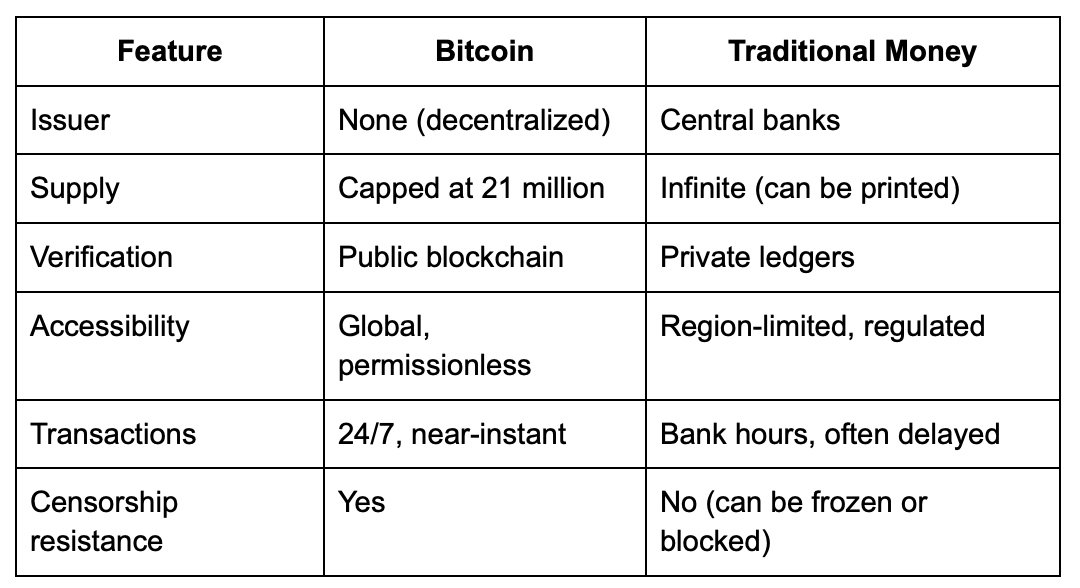
Bitcoin doesn’t replace national currencies, it offers an alternative monetary system that’s transparent, borderless, and self-governing.
Why people use Bitcoin
Different people use Bitcoin for different reasons:
Store of value: A hedge against inflation and monetary debasement.
Medium of exchange: Especially in unstable economies or for cross-border payments.
Freedom money: Protection from censorship or capital controls.
Investment: As a long-term speculative asset (“digital gold”).
Technological belief: A bet on open-source, decentralized networks replacing legacy finance.
Bitcoin’s ecosystem
Bitcoin’s simplicity is its strength — the base network is intentionally minimal, but a rich ecosystem has developed around it:
Lightning Network: A second layer for instant, low-fee payments.
Taproot upgrade: Improved privacy and smart contract capability.
Custody solutions: Wallets, multisig safes, and institutional-grade storage.
Infrastructure companies: Exchanges, payment processors, and mining firms.
Developers & open-source projects: Constantly improving scalability and usability.
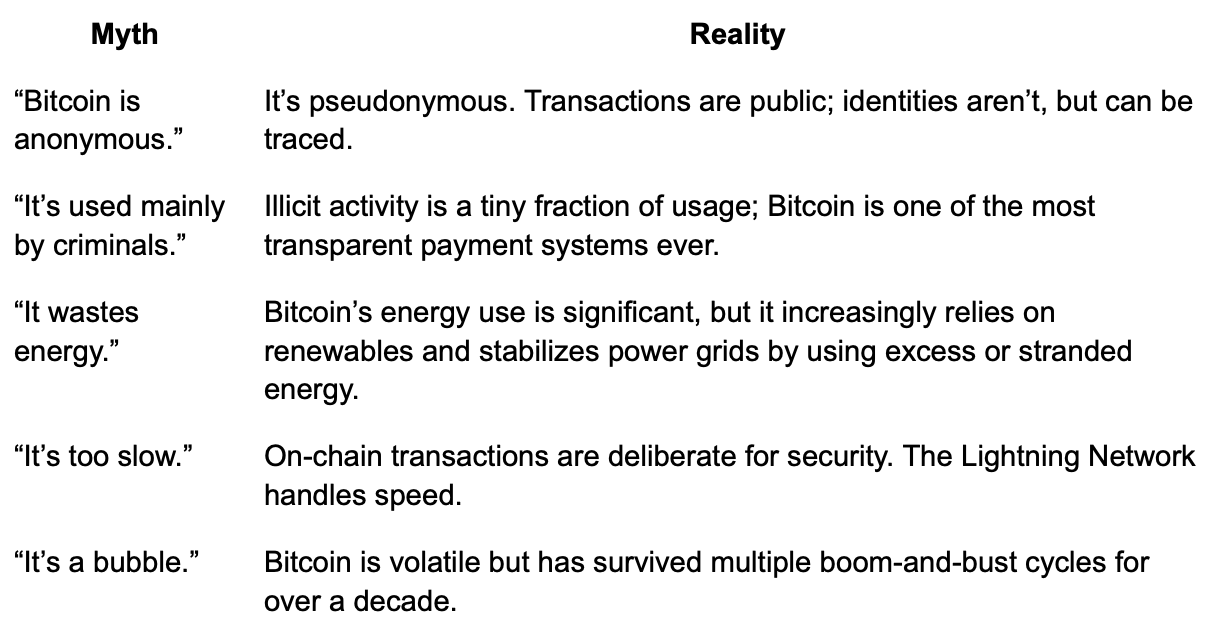
Common misconceptions
Bitcoin’s challenges
Volatility: Prices can move dramatically in short periods.
Regulation: Governments are still deciding how to classify it.
User security: Poor self-custody practices lead to losses.
Energy debate: Balancing security with sustainability.
Scalability: Bitcoin prioritizes decentralization over speed.
Why Bitcoin still matters
Bitcoin’s true importance isn’t just financial — it’s philosophical.
It’s the first digital system that allows global, peer-to-peer value exchange without central control.
That changes how humans can store, move, and preserve wealth — especially in places where banks fail or inflation destroys savings.
It’s also a living experiment in economic democracy:
Rules are transparent.
Participation is voluntary.
No one can rewrite history or mint more coins.
That’s never existed before.
The future of Bitcoin
Bitcoin isn’t evolving fast — it’s evolving carefully.
Its mission isn’t to do everything; it’s to be sound, incorruptible money.
Expect:
Wider institutional integration (ETFs, insurance, banking rails).
Continued Lightning Network adoption for instant payments.
Governments exploring Bitcoin-based reserves or legal tender models (like El Salvador).
Miners shifting to renewable and surplus energy sources.
Broader use as a global settlement layer — the internet’s monetary backbone.
Key takeaways
Bitcoin is decentralized digital money powered by cryptography and consensus.
It introduced digital scarcity — a fixed-supply asset that anyone can own, move, or verify.
It’s maintained by thousands of independent participants, not a single authority.
Its success comes from mathematical trust, not institutional trust.
Whether you see it as money, technology, or ideology — Bitcoin has already proven one thing:
Open, decentralized systems can create global value without permission.
The bigger picture
Bitcoin is to money what the internet was to information:
A protocol that removes gatekeepers and gives direct access to everyone.
And just like the early internet, Bitcoin isn’t perfect — but it’s unstoppable.
It’s not just a new kind of currency. It’s the foundation for a new kind of financial system.